
Plant Encyclopedia

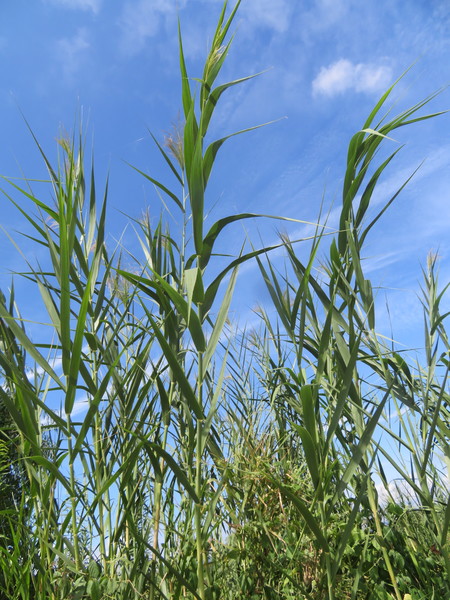
Phragmites karka ("Seitakayoshi")
Japanese name: セイタカヨシ (背高葭)
Scientific name: Phragmites karka
[Overview]
A colonial perennial 2–4 m tall, found in wet places near riverbanks and the seashore.
It is larger overall than Ashi.
It spreads by rhizomes extending underground but does not produce long aboveground stolons (runners).
The stem (culm) is hollow and cylindrical, 1–2 cm in diameter, and the nodes have no spreading hairs.
The leaves are alternate, linear to lanceolate, 30–70 cm long and 2–4 cm wide, with pointed tips; they ascend obliquely, and the tips do not hang down as in Yoshi.
The leaf margins and the undersides are rough.
The ligule is hair-like, about 0.1 cm long.
The leaf sheath is hairless and smooth.
The spikelets are densely set in a large panicle-like inflorescence 30–70 cm long.
The inflorescence is nearly twice as long as that of Yoshi, tinged with purple at first and later turning grayish brown.
The spikelets are stalked, no more than 1 cm long (0.5–0.8 cm), and usually consist of 4 florets; the rachilla has long white hairs.
The first glume is lanceolate and is usually no more than 1/2 the length of the lowest lemma.
The second glume is broadly lanceolate.
[Notes]
The Japanese name comes from its tall height.
The alternative name Seiko-no-yoshi (reed of West Lake) refers to West Lake in China.
Details
Translated from our Japanese encyclopedia. If anything differs, the Japanese page is correct.