
Plant Encyclopedia

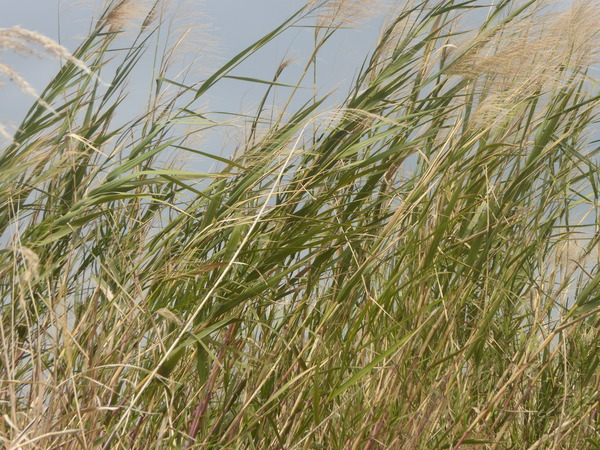
Phragmites australis ("Yoshi")
Japanese name: ヨシ (葭)
Scientific name: Phragmites australis
[Overview]
A colonial perennial 1–3 m tall, found in wet places such as riverbanks and lake margins.
It spreads by rhizomes extending underground but does not produce long aboveground stolons (runners).
The stem (culm) is hollow and cylindrical, and the nodes have no spreading hairs.
The leaves are alternate, linear to lanceolate, 20–50 cm long and 2–4 cm wide, with pointed tips; they ascend obliquely and the tips hang down.
The leaf margins are rough.
At the base of the leaf there are small ear-like projections on both sides.
The ligule is about 0.2 cm long and has hairs on the outside.
The upper part of the leaf sheath is usually pale green, with several long hairs at the mouth.
The spikelets are densely set in a large panicle-like inflorescence 15–40 cm long.
The spikelets are stalked, more than 1 cm long (1.2–1.7 cm), and consist of 2–4 florets; the rachilla has long white hairs.
The first glume is lanceolate and is usually no more than 1/2 the length of the lowest lemma.
The second glume is broadly lanceolate.
[Uses]
The rhizome is called rokon and is used as a crude drug.
Yoshizu (reed screens) are made from the stems.
[Cultivation]
Propagate by division.
It prefers a sunny location.
Paddy soil is suitable for planting.
The aboveground parts die back in winter, but do not let the water dry up at any time of year.
From spring to autumn, push slow-release fertilizer or fermented oil cake into the soil.
[Notes]
It was originally called Ashi, but because this connects to "ashi" (悪し, bad) and was considered ill-omened, it is said to have come to be called Yoshi (善し, good).
Details
Translated from our Japanese encyclopedia. If anything differs, the Japanese page is correct.