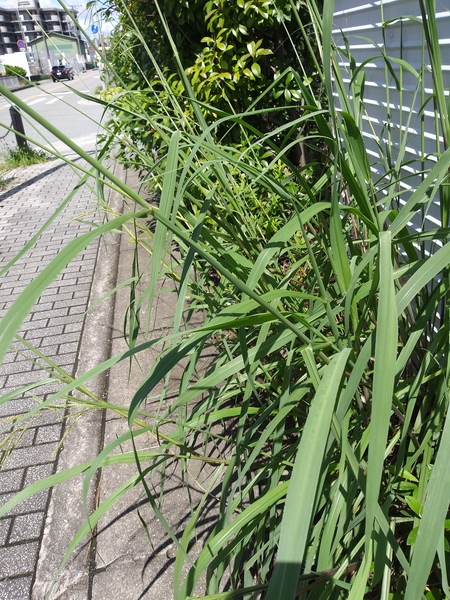
Japanese name: タチスズメノヒエ(立雀の稗) Scientific name:Paspalum urvillei
[Overview]
A perennial 0.7–1.5 m tall, found on sunny roadsides and in fields.
It has short rhizomes, and the culms (stems) grow in clumps.
The leaves are alternate and linear, 10–40 cm long and 0.5–1.5 cm wide, hairless on both sides or with sparse hairs on the underside.
The leaf sheaths on the upper part of the stem are hairless except at the mouth, while those of the basal leaves have spreading hairs.
The flower spike bears 10–20 racemes 4–10 cm long.
The racemes are erect or ascending, with long white hairs at the base, and the spikelets are arranged in 2–3 rows on one side of the axis.
The spikelets are ovate, 2–2.7 mm long, with long white hairs on the margin.
The stigmas are blackish purple and conspicuous at flowering.
The anthers are pale yellow.
[History]
It was first recorded on reclaimed land in Kitakyushu, Fukuoka, in 1958, and has naturalized in various places.