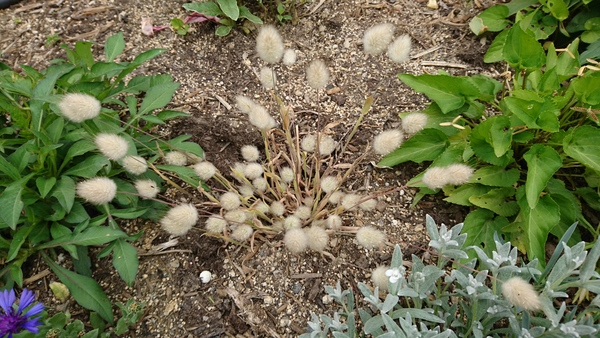
Japanese name: ウサギノオ(兎尾) Scientific name:Lagurus ovatus
[Overview]
An annual about 10–40 cm tall.
The whole plant is densely covered with soft hairs.
The culm (stem) branches at the base and stands erect.
The leaves are linear, about 1 cm wide.
A spherical to elliptical inflorescence about 2–3 cm long is borne at the stem tip, densely set with spikelets.
Each spikelet consists of one flower and has an awn 1–2 cm long.
[History]
Naturalization was reported in 1975 in Shirahama, Chiba, and it is now seen in various places.
[Cultivation]
Propagate from seed, covering the seeds with just enough soil to hide them.
It prefers sunny, well-drained soil.
For potted plants, water thoroughly when the soil surface dries; for plants in the ground, rainfall is sufficient.
If a base fertilizer is applied, no further fertilizing is particularly necessary.
Aphids may occur.
[Notes]
The Japanese name compares the bushy spikes to a rabbit's tail.