
Plant Encyclopedia

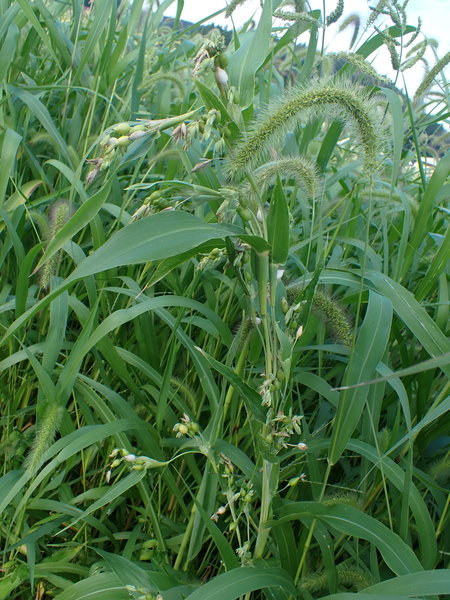
Coix lacryma-jobi (Job's tears, "Juzudama")
Japanese name: ジュズダマ (数珠玉)
Scientific name: Coix lacryma-jobi
[Overview]
A perennial 1–2 m tall, but because it is sensitive to cold, it becomes an annual in cold regions.
It grows in colonies mainly along water and in wetlands, and is also seen by roadsides and on vacant land.
Many stems emerge and it forms a large clump.
The leaves are simple and alternate, narrowly lanceolate to broadly linear, with a conspicuous thick white midrib.
The leaf base forms a sheath that clasps the stem.
The spikelets are of two kinds, male and female.
At the base of the inflorescence arising from the leaf axils in the upper part of the stem, a female spikelet is enclosed in a hard, urn-shaped involucre (bract sheath), and beyond it several male spikelets hang down.
The female spikelet consists of 1 floret, and the style, divided into two, protrudes outside the bract sheath.
Two reduced spikelets are borne beside the female spikelet.
The male spikelets consist of 2 florets.
The bract sheath is ovoid, about 1 cm long, becomes extremely hard when ripe, and is glossy, in colors such as grayish white, grayish brown and black.
[History]
It is thought to have been introduced in ancient times and then become wild.
[Uses]
The fruits are threaded on string to make prayer beads.
The fruits and roots are used medicinally.
The hard shell of the fruit is removed, and it can also be eaten as a minor grain.
[Cultivation]
Propagate from seed or by division.
It prefers sunny, moist places.
If the environment suits it, it grows well even when left alone.
Fertilizer is not particularly necessary.
There are no particular pests or diseases.
Details
Japanese: ジュズダマ(数珠玉)
Translated from our Japanese encyclopedia. If anything differs, the Japanese page is correct.