
Plant Encyclopedia

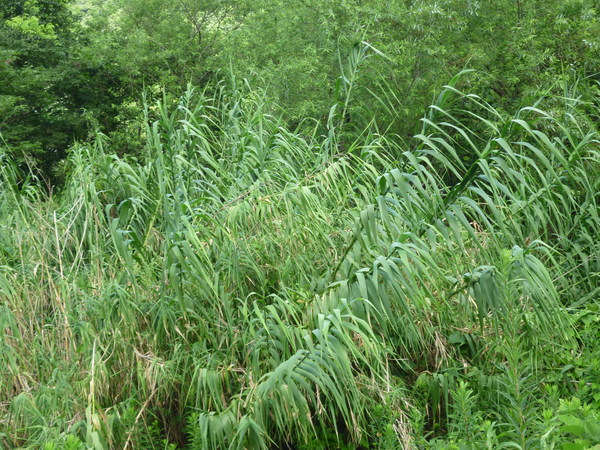
Arundo donax (giant cane, "Danchiku")
Japanese name: ダンチク (葮竹、暖竹)
Scientific name: Arundo donax
[Overview]
A large perennial that forms colonies, found on coastal dunes and riverbanks.
The rhizomes creep and spread.
The culm (stem) is hollow and jointed, thick at 2–4 cm across, and grows erect to 2–4 m tall.
First-year stems are green; from the second year on they turn brownish and hard.
The leaves are alternate, linear, 50–70 cm long and 2–5 cm wide, powdery green and thick, gradually tapering to a long point.
The leaves bend partway along and the tips droop.
The leaf sheaths clasp the leaf broadly, and the ligule is short with hairs on the margin.
An upright panicle-like inflorescence 30–70 cm long is held at the stem tip and densely bears many spikelets.
The inflorescence is glossy and sometimes tinged reddish purple.
Each spikelet consists of 2–5 florets.
The lemma is lanceolate and 8 mm or more long, with the tip split in two and an awn emerging from between the lobes.
[Uses]
The stems are used as reeds for woodwind instruments such as the clarinet and oboe.
They are also used as roofing material and for papermaking, and the rhizome is used medicinally under the name 芦竹根.
[Notes]
The Japanese name Danchiku (葮竹) is said to compare the culm to bamboo and the leaves to yoshi (ashi, common reed), and the 葮 in 葮竹 is said to derive from a miswriting of 葭.
Details
Japanese: ダンチク(葮竹、暖竹)、ヨシタケ(葦竹)
Translated from our Japanese encyclopedia. If anything differs, the Japanese page is correct.