
Plant Encyclopedia

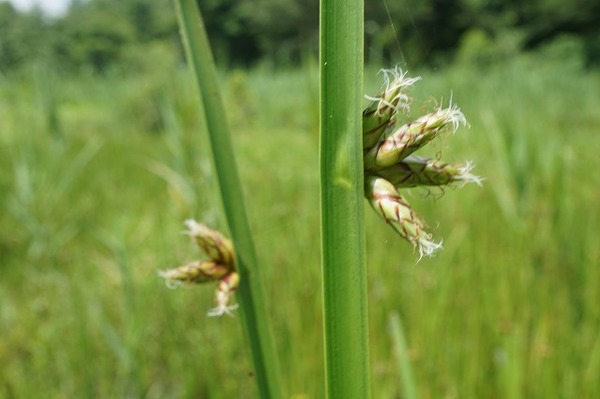
Schoenoplectus triangulatus ("Kangarei")
Japanese name: カンガレイ (寒枯藺)
Scientific name: Schoenoplectus triangulatus
[Overview]
A perennial 0.5–1.2 m tall, found in wetlands along ponds, marshes and riverbanks.
It has a short rhizome.
The stems grow in tufts forming clumps, triangular-prism-shaped, 50–120 cm long and 0.3–1 cm wide, with sharp angles and concave sides.
There are no nodes above the base of the stem.
The leaves are basal but consist only of tubular leaf sheaths 8–30 cm long.
2–25 spikelets gather at the stem tip to form the inflorescence, but because the involucral bract stands upright or extends obliquely, the inflorescence appears to be lateral.
There is usually one involucral bract, 1–12 cm long, with nearly the same form as the stem.
The spikelets are elliptical to lanceolate, 1–2 cm long, and stalkless.
The scales of the spikelet are ovate, 0.4–0.5 cm long, and often have brownish margins.
There are 6 bristle-like perianth segments, equal to or about twice as long as the fruit, rough in a downward direction.
The fruit is glossy blackish brown, obovate with 3 angles, 0.2–0.3 cm long, smooth or with indistinct transverse wrinkles.
[Uses]
The root is called hosokon (蒲草根) and is used medicinally.
[Cultivation]
Propagate by division.
It prefers a sunny location.
Paddy soil is suitable for planting.
For potted plants, submerge the whole pot in water so that the base of the plant is under water.
The aboveground parts die back in winter, but do not let the water dry up at any time of the year.
From spring to autumn, push slow-release fertilizer or fermented oil cake into the soil.
Details
Translated from our Japanese encyclopedia. If anything differs, the Japanese page is correct.