
Plant Encyclopedia

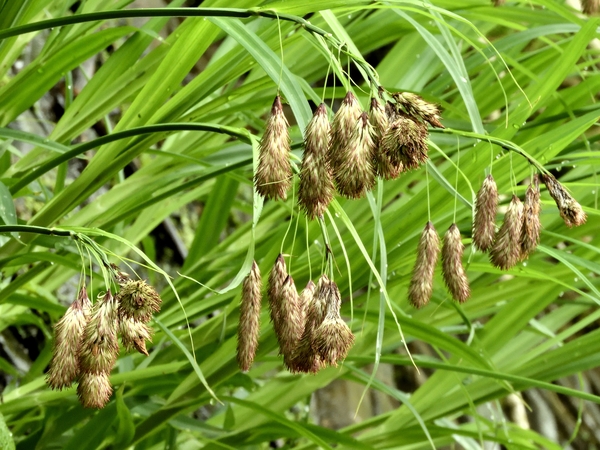
Carex podogyna ("Tanukiran")
Japanese name: タヌキラン (狸蘭)
Scientific name: Carex podogyna
[Overview]
A perennial growing on damp rocky ground in the mountains.
It has a short rhizome.
The leaves are linear, about 0.5–1 cm wide, with rough margins.
The leaf bases form soft sheaths.
The stem tip bears 3–6 spikelets; the upper 1–3 spikelets are male and lanceolate.
The lower 2–4 are female, broadly elliptic, 2–4 cm long, and hang down on slender stalks.
The female scales are blackish brown and lanceolate, ending in a short awn at the tip.
The perigynia are lanceolate, about 1.2–1.5 cm long, without veins, and stalked.
The upper end of the perigynium forms a beak.
[Cultivation]
Propagate from seed or by division.
The seeds need light to germinate, so cover them with only a very thin layer of soil.
It grows in sun to partial shade and prefers well-drained, moisture-retentive soil.
It is better to let it spend midsummer in cool partial shade.
Keep it on the moist side; for potted plants, water thoroughly when the soil surface dries, and for plants in the ground, water if sunny weather continues and the soil dries out.
If fertilizer is applied at planting, none is particularly needed.
There are no particular pests or diseases.
[Notes]
The name likens the bushy spikelets to a tanuki's (raccoon dog's) tail.
Details
Translated from our Japanese encyclopedia. If anything differs, the Japanese page is correct.