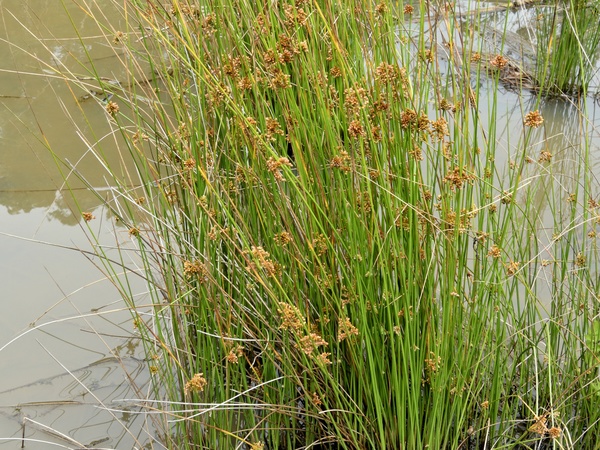
Japanese name: イグサ(藺草) Scientific name:Juncus decipiens
[Overview]
A perennial 20–100 cm tall, growing in sunny, wet places such as marshes and fallow paddy fields, or in shallow water at the water's edge.
It has a rhizome.
The stems are cylindrical, thin and numerous.
The leaves are reduced to reddish-brown, glossy, scale-like sheathing leaves attached at the base of the stem.
An inflorescence of many clustered flowers is borne at the stem tip, but the lowest bract of the inflorescence is 10–20 cm long, shaped like the stem and upright, so the inflorescence appears to be lateral.
The flowers are small, with 6 tepals that are lanceolate with pointed tips and greenish brown.
There are 3 stamens, and the anthers are slightly shorter than the filaments.
The fruit is a capsule with 3 chambers, and the seeds are obovate.
[Cultivation]
Propagate by division.
It prefers a sunny location.
[Notes]
A cultivar called Ko-hige is processed into tatami omote (the woven surface of tatami mats).
Because the pith of the stem was soaked in oil and burned as a lamp, it has the other name Toshinso.