
Plant Encyclopedia

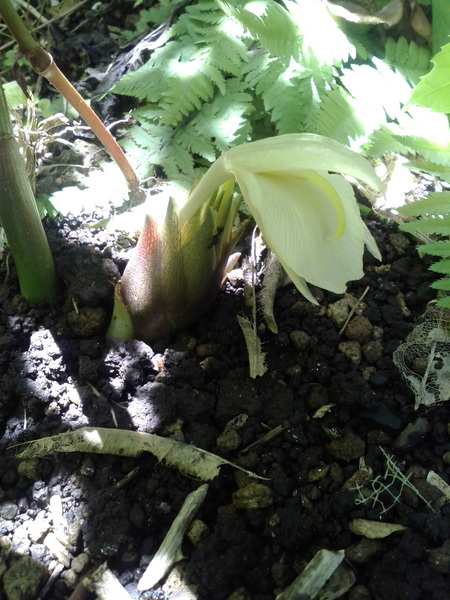
Zingiber mioga (mioga)
Japanese name: ミョウガ (茗荷)
Scientific name: Zingiber mioga
[Overview]
A perennial 40–100 cm tall.
It can be found in the wild but is usually cultivated.
It has slender, cylindrical underground stems with many nodes, which run horizontally underground.
The leaves are simple, borne alternately in two rows, oblong to lanceolate, 20–30 cm long and 3–6 cm wide.
The leaf bases wrap around the stem like sheaths and overlap, forming a pseudostem.
The flower stalk extends from the tip of the underground stem separately from the pseudostem, is about 5–10 cm tall, and bears at its tip an oblong inflorescence 5–7 cm long.
The inflorescence has densely set reddish-green bracts, and flowers open one after another from between them.
The flowers are 5 cm across and pale yellow, and a single staminode develops into a petal-like structure and is conspicuous.
Each flower withers in a day.
The fruit is seldom seen; it is a capsule that splits open when ripe, is red inside, and shows a distinctive appearance with black seeds wrapped in a white aril.
There are two strains, summer myoga and autumn myoga, depending on when the flowers appear.
[History]
The plants growing wild are thought to have been introduced from China long ago and then become naturalized.
[Uses]
The inflorescences and young stems and leaves are pungent and fragrant, and are used as an aromatic vegetable.
The inflorescence is called "Hana-myoga" or "Myoga-no-ko," and the young stems and leaves are called "Myoga-take."
[Cultivation]
Propagate by underground stems.
It prefers humus-rich soil that is well drained and moderately moist.
It grows in sun to partial shade.
Diseases include rhizome rot and blast.
Details
Japanese: ミョウガ(茗荷)
Translated from our Japanese encyclopedia. If anything differs, the Japanese page is correct.