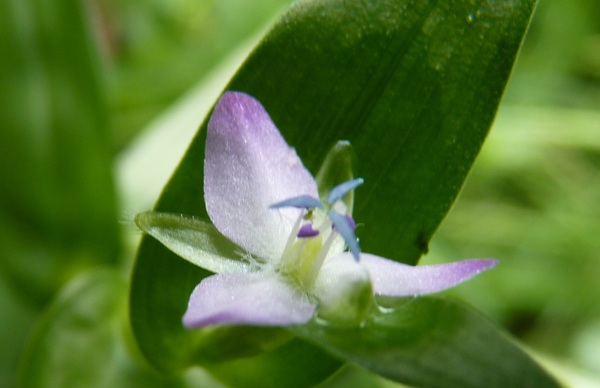
Japanese name: イボクサ(疣草) Scientific name:Murdannia keisak
[Overview]
An annual 20–30 cm tall, found in wetlands and at the waterside.
It is somewhat succulent and soft, and the lower part of the stem creeps along the ground and branches.
The stem is often tinged with red.
There are no basal leaves.
The leaves are simple and alternate, lanceolate, 3–7 cm long and 0.5–1 cm wide, with pointed tips and entire margins.
The leaf base wraps around the stem like a sheath.
Usually 1 flower is borne at the stem tip or in a leaf axil.
The flower has 3 ovate petals, pale pink at the tip and white in the lower half.
There are 3 green, lanceolate sepals.
Of the 6 stamens, only 3 are fully developed, with white hairs on the lower part of the filament and linear, pale bluish-purple anthers.
The other 3 stamens are staminodes, with heart-shaped, purple to reddish-purple anthers.
Each flower withers in a day.
There are no boat-shaped bracts.
The fruit is an elliptical capsule, borne hanging downward on a bent fruit stalk.
[Notes]
The Japanese name derives from the belief that the sap of the leaves removes warts.