
Plant Encyclopedia

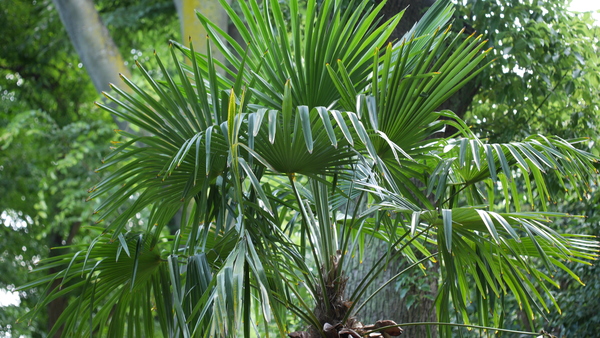
Trachycarpus fortunei (Chinese windmill palm, "Shuro")
Japanese name: シュロ (棕櫚)
Scientific name: Trachycarpus fortunei
[Overview]
An evergreen tree-form palm 3–7 m tall with a trunk 10–15 cm in diameter.
The trunk is erect, and its upper part is covered with the petioles of dead leaves and the old fibrous leaf sheaths.
The leaves are borne densely and alternately at the top of the trunk; they are fan-shaped and round, 50–80 cm in diameter, deeply divided fan-wise into many segments to about 1/3 of the leaf length, and each segment is further shallowly divided into two at the tip, which breaks and hangs down as the leaf ages.
The petiole is 60–100 cm long and 4–5 cm wide, with spiny projections on the margin.
It is dioecious.
Both male and female flowers have 3 petals and are borne in large numbers on panicles 30–40 cm long emerging from the leaf axils.
The male inflorescences bear pale yellow male flowers, and the female inflorescences bear pale green female flowers and bisexual flowers.
The fruit is an oblate berry 10–12 mm long and 6–9 mm wide, ripening greenish black.
The very similar Tojuro can be distinguished by its leaf tips, which do not break.
[Uses]
The trunk was used as building material.
The fibrous leaf sheaths are strong and water-resistant, and are used to make scrubbing brushes, palm rope (shuro-nawa) and brooms.
The young leaves are bleached and used to make mats and hats.
The leaves, called shuroyo, are used together with the seeds as a folk medicine.
[Cultivation]
Propagate from seed.
In its native range it grows up to an altitude of 2,400 m, so it is very cold-hardy and tolerates temperatures down to −15 °C; even in snowy regions it can overwinter with protection such as a snow fence.
Avoid transplanting in the cold season.
It prefers fertile, well-drained soil.
It prefers partial shade to shade, but also grows in full sun.
Rainfall is sufficient for watering.
Apply organic fertilizer in winter by digging holes around the plant.
Cut off dead or damaged leaves at the base of the petiole after new leaves have emerged.
If you do not need seeds, cutting off the flower spikes as early as possible keeps the plant from tiring.
There are no particular pests or diseases.
[Notes]
South of the Kanto region, plants that have sprouted from seeds carried by birds and become wild are often seen.
Details
Japanese: シュロ(棕櫚)、ワジュロ(和棕櫚)
Translated from our Japanese encyclopedia. If anything differs, the Japanese page is correct.