
Plant Encyclopedia

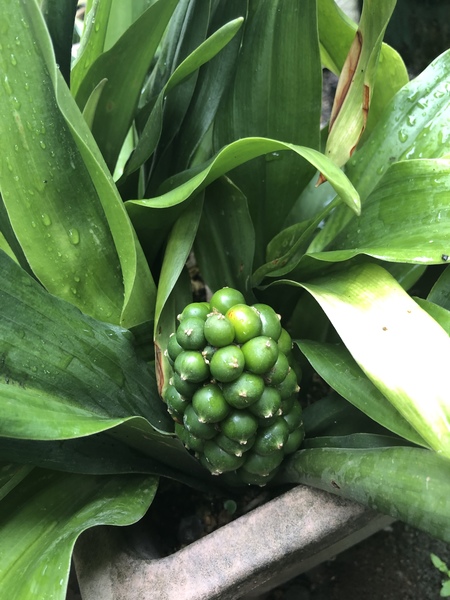
Rohdea japonica var. japonica (Nippon lily, "Omoto")
Japanese name: オモト (万年青)
Scientific name: Rohdea japonica var. japonica
[Overview]
An evergreen perennial 30–50 cm tall, found in evergreen broadleaf forests in warm regions.
It has a thick rhizome.
The leaves are basal, lanceolate, 30–50 cm long, dark green, thick and glossy, and stalkless.
The leaves are renewed every 2–3 years, and the old lower leaves die first.
A thick flower stalk 10–20 cm tall stands erect and bears a spike-like inflorescence at the tip, densely packed with many flowers.
The inflorescence is rod-shaped and looks like a spadix.
The flowers are pale yellow with 6 petals, about 0.5 cm across; the tepals are thick and fused at the base to form a bowl shape.
The fruit is spherical, about 1 cm in diameter, green at first and later ripening to vermilion.
[History]
It is a classical horticultural plant enjoyed for variations in its "gei" (ornamental qualities), such as leaf shape and variegation pattern, and many cultivars were produced in the Edo period.
[Uses]
It is extremely toxic and is not generally used, but it has medicinal properties.
[Cultivation]
Propagate mainly by division, but propagation from seed is also possible.
It can overwinter outdoors in regions without freezing.
Protect it from cold winter winds as well.
It prefers soil that is well drained and retains water well.
Strong direct sunlight causes leaf scorch, so a spot in partial shade is suitable from spring to autumn, and in winter give it plenty of sun.
From spring to autumn, water thoroughly when the soil surface dries; keep it on the dry side in winter.
Fertilize sparingly: apply a base fertilizer, and in spring and autumn either place a small amount of slow-release fertilizer on the soil or give diluted liquid fertilizer, making sure no fertilizer remains in midsummer.
Pests include spider mites, scale insects and slugs.
Details
Japanese: オモト(万年青)
Translated from our Japanese encyclopedia. If anything differs, the Japanese page is correct.