EVERGREEN

Plant Encyclopedia

Polygonatum humile

Polygonatum humile ("Himeizui")

Japanese name: ヒメイズイ (姫萎蕤)
Scientific name: Polygonatum humile

Polygonatum humile

[Overview]
A perennial 10–45 cm tall, found on coasts and in grasslands.
The rhizome is cylindrical, 3–4 mm in diameter, and extends outward.
The stem is erect and ridged.
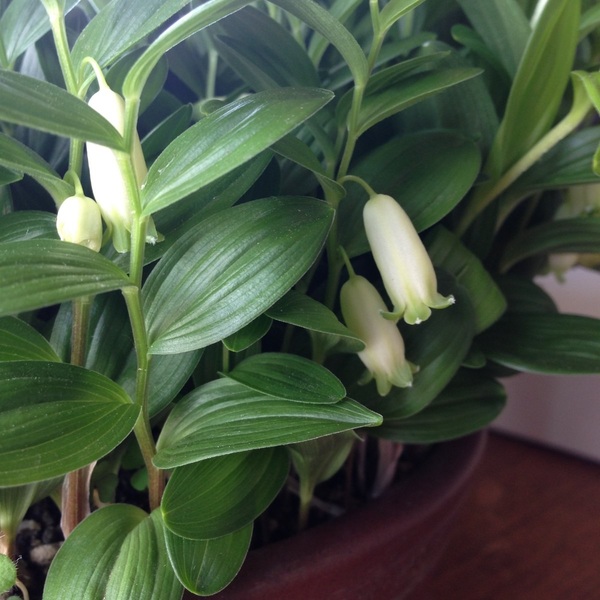
The leaves are simple and alternate, oblong, 5.5–8.5 cm long and 1.5–4 cm wide, with entire margins.
The flowers are solitary in the leaf axils and hang down; they are long and tubular, white to cream with green tips.
The fruit is a spherical berry 0.8–1 cm in diameter, ripening black.

[Cultivation]
Propagate by division.
It is not particular about soil as long as the site is well drained and well ventilated.
It prefers a place with sun from autumn to spring and partial shade in midsummer.
It is easy to grow.
Water thoroughly when the soil surface dries.
If base fertilizer is applied, further fertilizing is not particularly necessary, but organic fertilizer in winter improves growth from spring and makes the clump thicker.
There are no particular pests or diseases.

[Notes]
Izui is another name for Amadokoro.

Details

Names
Japanese: ヒメイズイ(姫萎蕤)、ヒメアマドコロ(姫甘野老)
Life form
Perennial
Habit
Terrestrial
Planting (or sowing) season
March, October, November
Flowering season
May, June, July
Distribution or origin
Japan (Hokkaido, Honshu: Shiga and north, Kyushu (?)), southern Korea, China, Mongolia, Siberia to Sakhalin, Urup Island, southern Kuril Islands
Height
100–450 mm
Leaf shape
Simple leaf (unlobed)
Leaf arrangement
Alternate
Leaf margin
Entire
Inflorescence
Solitary
Flower color
Yellowish white, White
Fruit color
Other
Leaf color
Green
Availability of seeds and plants
Low
Form sold
Seedlings
Propagation
Division
Sun exposure
Full sun, Partial shade
Water needs
Moderate
Soil needs
Required
Tolerance
Cold tolerance
Suitable uses
Potted plant
Japan Flower Trade Code
58397

Translated from our Japanese encyclopedia. If anything differs, the Japanese page is correct.

Sponsored