
Plant Encyclopedia

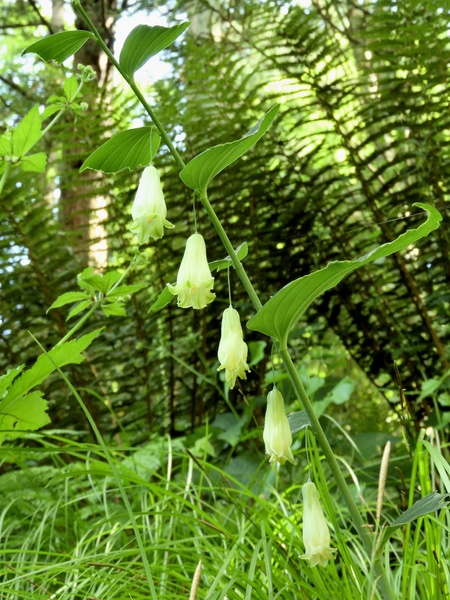
Polygonatum falcatum var. falcatum ("Narukoyuri")
Japanese name: ナルコユリ (鳴子百合)
Scientific name: Polygonatum falcatum var. falcatum
[Overview]
A perennial 60–80 cm tall, found at woodland edges and in grassland in the mountains.
The rhizomes are 0.5–1.5 cm in diameter and connected like a string of beads.
The stem is cylindrical, 40–140 cm long, and arches in the upper part.
The leaves are simple and alternate in two rows, lanceolate to oblong, 7–23 cm long and 0.9–4 cm wide, with entire margins.
Corymbs arise from the leaf axils, each hanging 2–6 long bell-shaped white flowers with green tips.
The fruit is a spherical berry 0.7–1 cm in diameter, ripening dark green.
[Uses]
The rhizome is used medicinally.
[Cultivation]
Propagate by division.
Cut the rhizome apart at the point where it branches.
It is not particular about soil as long as the site is well drained and airy.
It prefers sun from autumn to spring and partial shade in midsummer.
It is easy to grow.
For potted plants, water thoroughly when the soil surface dries; for plants in the ground, rainfall is sufficient.
Fertilizer is not particularly needed if base fertilizer is applied, but organic fertilizer in winter improves growth from spring and thickens the clump.
Because the underground stems extend sideways, a plant left in the ground for several years will shift position, so replant it at that point.
There are no particular pests or diseases.
[Notes]
The Japanese name likens the drooping flowers to a naruko (a clapper used to scare birds away in rice fields).
Details
Translated from our Japanese encyclopedia. If anything differs, the Japanese page is correct.