
Plant Encyclopedia

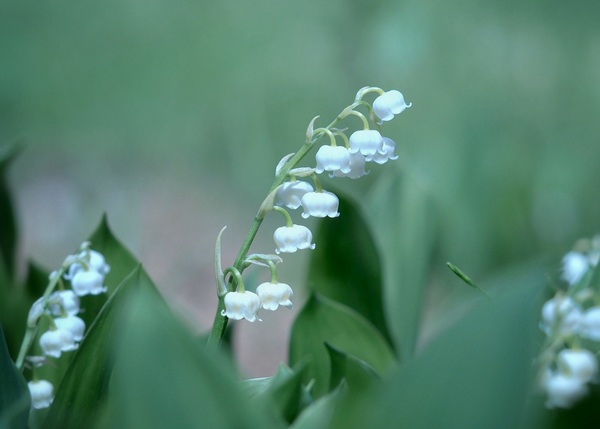
Convallaria majalis var. manshurica (lily of the valley, "Suzuran")
Japanese name: スズラン (鈴蘭)
Scientific name: Convallaria majalis var. manshurica
[Overview]
A perennial growing in open woods and grasslands in the mountains.
It spreads by long creeping rhizomes and sometimes forms colonies.
Two leaves arise from the base, ovate-oblong, 10–18 cm long and 3–7 cm wide, with entire margins.
The leaf base forms a long sheath, and several scale leaves are attached below.
The leaves grow large by the time the flowers bloom.
Flower stalks 20–35 cm tall arise from the axils of the scale leaves at the leaf base, but because the leaves are also well developed, the stalks are lower than the leaves.
The flower stalk forms a raceme leaning to one side and bears about 10 flowers facing downward.
The flowers are about 1 cm across, white, broadly bell-shaped and 6-petaled, but because the tepals are fused to about the middle, they look 6-lobed.
The tips of the tepals curve back.
The anthers of the stamens are bright yellow.
The flowers are fragrant.
The fruit is a spherical berry 6–8 mm in diameter that ripens red.
[Uses]
The whole plant is poisonous, but the rhizome is used medicinally.
[Cultivation]
Propagate from seed or by division.
It prefers a well-drained place.
Its native habitat is cool, so it dislikes heat and humidity; it is best planted where it receives partial shade in summer, such as under deciduous trees.
If the site is too dark, it flowers poorly.
For potted plants, water thoroughly when the soil surface dries.
In the garden, if the place dries easily, water thoroughly when the soil surface dries.
In a moist place, no particular watering is needed.
Apply slow-release chemical fertilizer as base fertilizer, and from spring to autumn give diluted liquid fertilizer about twice a month.
Southern blight can occur.
[Notes]
The alternative name kimikage-so comes from the way the flowers bloom as if hidden in the shade of the leaves.
Most plants grown for ornament under the name suzuran are German lily of the valley (Doitsu-suzuran).
Doitsu-suzuran can be distinguished by its flower stalks being taller than the leaves and its yellowish-green anthers.
Details
Japanese: スズラン(鈴蘭)、キミカゲソウ(君影草)、タニマノヒメユリ(谷間の姫百合)
Translated from our Japanese encyclopedia. If anything differs, the Japanese page is correct.