
Plant Encyclopedia

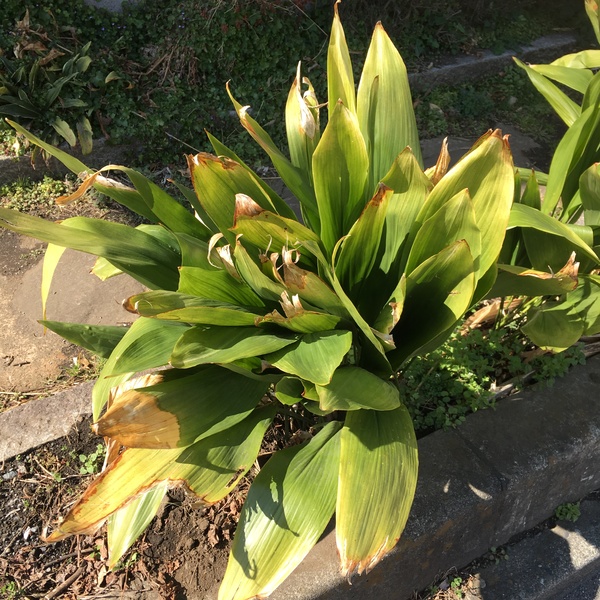
Aspidistra elatior (aspidistra, "Haran")
Japanese name: ハラン (葉蘭)
Scientific name: Aspidistra elatior
[Overview]
An evergreen perennial found in broadleaf forests.
It has a creeping, cylindrical rhizome 5–14 mm across.
The leaves are simple and arise erect, one from each node of the rhizome; they are oblong, 30–65 cm long, and pointed at both ends.
The upper surface of the leaf is dark green and glossy, with a conspicuous midrib.
The petiole is 25–55 cm long.
The flowers open upward at ground level at the base of the plant; they are about 2–3 cm across, dark purple inside, and fleshy.
The corolla is 8-lobed.
A large peltate stigma spreads across the inside of the corolla like a lid.
The fruit is a spherical berry 2–2.8 cm across.
[History]
As a traditional ornamental plant, variegated forms and forms with altered leaf shapes have been cultivated since the Edo period.
It was thought to have come from China, but it does not grow wild in China.
[Uses]
The rhizome is used medicinally.
The leaves are used for arranging and decorating dishes.
[Cultivation]
Propagate by division.
It prefers partial shade to shade and well-drained soil.
Strong direct sunlight causes leaf scorch.
From spring to autumn, water thoroughly when the soil surface begins to dry; in winter, water sparingly.
In addition to base fertilizer, apply organic fertilizer around the plant as fertilizer in winter.
For variegated cultivars, take care, as too much fertilizer can make the variegation disappear.
Remove damaged or dead leaves as needed.
Scale insects can occur.
Details
Japanese: ハラン(葉蘭)、バラン(馬蘭)
Translated from our Japanese encyclopedia. If anything differs, the Japanese page is correct.