
Plant Encyclopedia

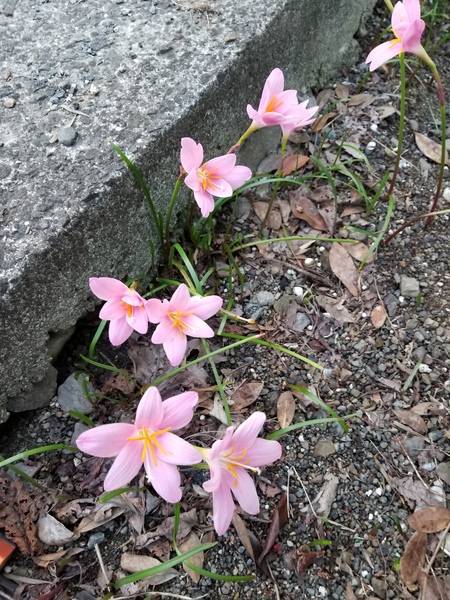
Zephyranthes carinata (rain lily, "Safuranmodoki")
Japanese name: サフランモドキ
Scientific name: Zephyranthes carinata
[Overview]
An evergreen perennial about 20–30 cm tall.
It has an ovate bulb 1–3 cm across underground.
The leaves are alternate, thick and linear, 15–30 cm long and 0.6–0.8 cm wide, growing in tufts of about 6.
The leaf bases are tinged with red, and the surface is glossy.
A single pink flower is borne at the tip of a flower stalk 10–30 cm tall.
The flowers are about 6 cm across and face upward; the perianth is 6-lobed, and the bases of the tepals are tinged with pale green.
Each flower closes after 1–3 days, but flower stalks keep emerging one after another, so the flowering period is long.
The fruit is a capsule.
[History]
It arrived in Japan around 1845 (Koka 2).
It is hardy and sometimes grows wild in warm regions.
[Cultivation]
Propagate by dividing the bulbs.
It prefers a fertile, well-drained place in sun to partial shade.
Water when the soil surface dries.
For plants in the garden, water if there are several days without rain.
Apply base fertilizer, and also a fertilizer high in potassium after flowering.
There are no particular pests or diseases.
[Notes]
The leaves and bulb contain a toxic component called lycorine, so care is needed not to eat them by mistake for Chinese chives, asatsuki (a type of chive), or nobiru (wild garlic).
Details
Japanese: サフランモドキ
Translated from our Japanese encyclopedia. If anything differs, the Japanese page is correct.