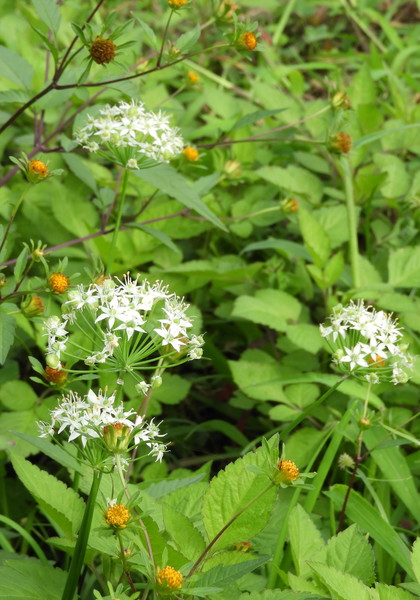
Japanese name: ニラ(韮) Scientific name:Allium tuberosum
[Overview]
A perennial with a distinctive odor.
The leaves are flat and linear, 30–40 cm long and 3–10 mm wide, with ridged veins on the underside.
The leaf sheaths are tinged with red, and the base forms a small bulb.
An erect flower stalk about 50 cm tall bears a hemispherical umbel at its tip, with 20–40 small white flowers.
[History]
It has long been cultivated as a vegetable.
It is thought to have reached Japan in the Yayoi period, and it appears in the Kojiki and the Man'yoshu under names such as kamira and kukumira.
[Uses]
It is rich in nutrients, including carotene.
The leaves are used in stir-fries and as a filling for gyoza.
The young, tender flower stalks and buds are eaten as hana-nira.
Leaf nira grown blanched is called ki-nira or nanpaku-nira.
The flowers are also edible, and the seeds are used as a crude drug.
[Cultivation]
It prefers fertile, well-drained, slightly alkaline soil.
It tolerates heat and dryness.
Propagate from seed.
Pests and diseases include rust, southern blight, aphids, onion thrips, bulb mites and cutworms.