
Plant Encyclopedia

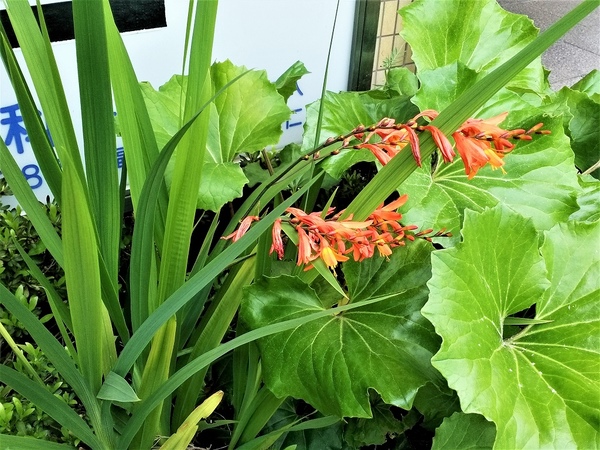
Crocosmia × crocosmiiflora (montbretia, "Himehiogizuisen")
Japanese name: ヒメヒオウギズイセン (姫檜扇水仙)
Scientific name: Crocosmia × crocosmiiflora
[Overview]
A perennial about 60–100 cm tall, produced by a cross between Hiogi-zuisen (Crocosmia aurea) and Hime-toshobu (Crocosmia pottsii).
It has an underground corm; stolons (underground stems) extend from each node and form new corms at their tips, so it multiplies readily.
The leaves grow from the base; they are sword-shaped, 60–100 cm long, and upright.
The flower stalk is wiry and upright, reaching about 80 cm tall, and branches into 3–5, each branch bearing a spike-like inflorescence.
Each inflorescence bears 12–20 flowers, somewhat biased to one side of the stem.
The flowers are 3–5 cm across, and the corolla is 6-lobed, orange to deep crimson.
There are 3 stamens, which project out of the flower together with the style; both are golden.
The fruit is a spherical capsule.
[History]
Breeding began in 1879 by P.L.V. Lemoine of France.
It is said to have been introduced to Japan as an ornamental in the mid-Meiji period (around 1890), and today naturalized plants can be seen around houses and in coastal grasslands.
[Cultivation]
Propagate mainly by division.
The corms do not divide, so divide the corms formed at the tips of the stolons (underground stems).
When planting corms, space them 20–30 cm apart at a depth of about 10 cm; they may be left in place for several years.
It can also be grown from seed, but it takes several years to flower.
It prefers a sunny, well-drained place, but it is very vigorous and grows easily anywhere.
It is not very cold hardy, but if protected from frost with a straw mulch or similar so that the corms in the ground do not freeze, it will put out leaves the next year.
In regions with severe cold, it is safer to dig up the corms in autumn and store them.
Rainfall is sufficient for watering unless sunny weather continues for a very long time.
Fertilizer is also hardly necessary; if too much is given, the plants grow too dense and crowded, flowering becomes poor, and the plants become leggy and fall over easily.
There are no particular pests or diseases.
[Notes]
It is also sold under the former genus names Montbretia and Tritonia.
Details
Japanese: ヒメヒオウギズイセン(姫檜扇水仙)、モントブレチア、トリトニア
Translated from our Japanese encyclopedia. If anything differs, the Japanese page is correct.