
Plant Encyclopedia

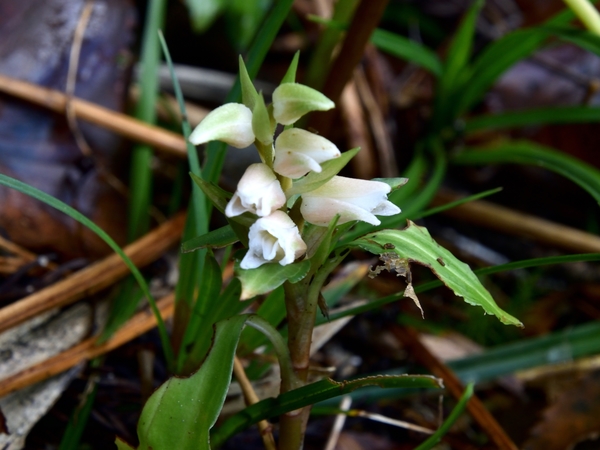
Goodyera foliosa var. laevis ("Akebonoshusuran")
Japanese name: アケボノシュスラン (曙繻子蘭)
Scientific name: Goodyera foliosa var. laevis
[Overview]
A perennial 5–10 cm tall, found in forests.
The stem creeps at the base, produces roots from the nodes, and rises in the upper part.
The leaves are simple and alternate, 4–5 in number, ovate, 2–4 cm long and 1–2 cm wide, without markings.
The leaf base is asymmetrical and runs down into a petiole 1.5 cm long.
A raceme bears 3–7 flowers, somewhat turned to one side.
The flowers are pale reddish purple and open in a bell shape.
At the base of each flower is a lanceolate bract.
[Cultivation]
Propagate by division, leaving 2–3 roots and several nodes on each piece.
It prefers partial shade and a well-drained, moisture-retentive medium, but it can also be grown in sphagnum moss alone.
Repot once a year, which also renews the medium.
Take care to prevent freezing in winter.
Water when the medium begins to dry, pouring gently from the edge of the pot so that water does not collect in the center of the leaves.
In spring and autumn, give diluted liquid fertilizer about once every 2 weeks in place of water.
After flowering, cut the flower stalk off at the base as soon as possible.
Pests and diseases include soft rot, virus disease and slugs.
Details
Translated from our Japanese encyclopedia. If anything differs, the Japanese page is correct.