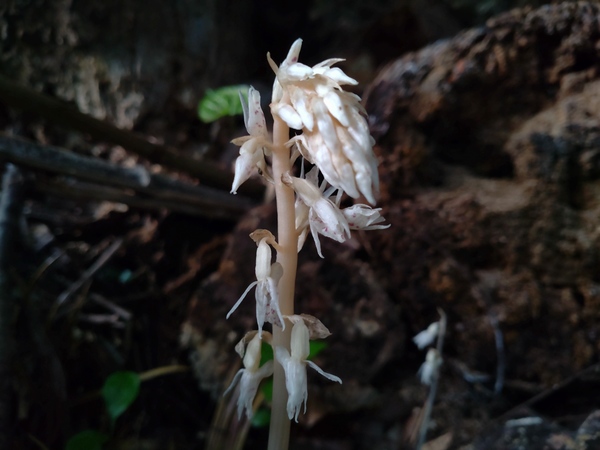
Japanese name: タシロラン(田代蘭) Scientific name:Epipogium roseum
[Overview]
A perennial 20–50 cm tall, found in evergreen forests.
It is a mycoheterotrophic plant and has no chlorophyll, so the whole plant is yellowish white.
It has a thick, lumpy rhizome, and the aerial stem is erect.
Several leaves are borne alternately on the stem; they are sheath-like and membranous.
A raceme bears rather many flowers, and each flower has a membranous bract.
The bracts are lanceolate, 0.8–2.2 cm long.
The flowers are white; the sepals and lateral petals are lanceolate, 0.8–0.9 cm long, with pointed tips.
The lip is broadly ovate, 0.8–0.9 cm long, with reddish purple spots, and has two crest-like ridges at the center of the inner side.
The spur is oblong, 0.4 cm long.
The ovary is elliptical and large, about 0.5 cm long.
The fruit is a capsule.
[Notes]
The Japanese name commemorates Tashiro Zentaro, who first discovered it in Japan.