
Plant Encyclopedia

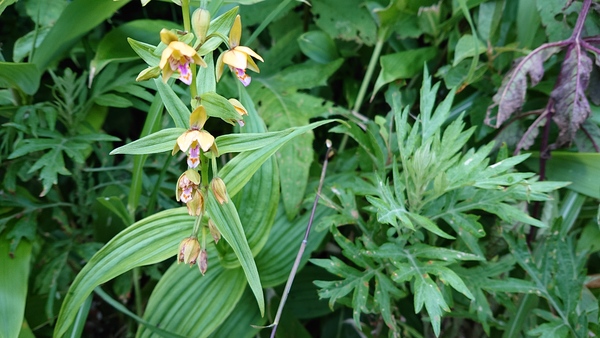
Epipactis thunbergii ("Kakiran")
Japanese name: カキラン (柿蘭)
Scientific name: Epipactis thunbergii
[Overview]
A perennial 30–70 cm tall, growing in sunny wetlands.
A terrestrial orchid.
It has a creeping rhizome and produces roots from the nodes.
The whole plant is hairless.
The stem is erect, tinged with purple at the base, and bears a few sheath-like leaves.
The leaves are simple and alternate, 5–10 in number, narrowly ovate, 7–12 cm long and 2–4 cm wide.
The leaves have wrinkled veins, and the base clasps the stem like a sheath.
A raceme bears about 10 flowers, which open from the bottom of the inflorescence upward.
The bracts are about as long as the flowers.
The flowers are yellowish brown; the sepals are narrowly long-ovate, 1.2–1.5 cm long and tinged with green, and the lateral petals are ovate and about as long as the sepals.
The lip has an orange and reddish purple pattern, and the side lobes project like ears.
The fruit is a capsule.
[Cultivation]
Propagate by division.
It is cold-hardy, but freezing can damage the buds, so in cold regions with little snow cover, protect it from frost or use mulch to prevent freezing.
It prefers soil that is well drained and moisture-retentive, and it can also be planted in sphagnum moss alone.
From autumn to spring, place it in full sun or where it receives sun only in the morning; strong direct sunlight and afternoon sun in midsummer can scorch the leaves, so place it in partial shade in summer.
It may also be grown under deciduous trees.
It dislikes dryness, so from spring to autumn water thoroughly when the surface of the planting medium starts to dry, and in winter dormancy water enough to keep it from drying out completely.
Apply liquid fertilizer once every 2 weeks during the growing season.
After flowering, organic fertilizer may also be placed on the soil as a thank-you fertilizer.
There are no particular pests or diseases.
[Notes]
The Japanese name compares the color of the flowers to the color of persimmon fruit.
Details
Translated from our Japanese encyclopedia. If anything differs, the Japanese page is correct.