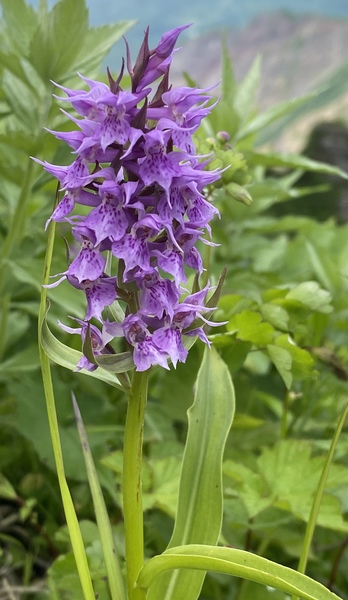
Japanese name: ハクサンチドリ(白山千鳥) Scientific name:Dactylorhiza aristata
[Overview]
A perennial 10–40 cm tall, found in sunny, moist grassland around snowfields and wetlands in the upper subalpine zone, from the subarctic to the cool-temperate region.
Part of the roots is thickened in a palmate shape.
The leaves are simple and alternate, 3–6 in number, oblanceolate, 5–15 cm long and 1–3 cm wide, without a petiole; the base clasps the stem like a sheath.
A raceme at the stem tip bears reddish purple flowers.
The dorsal sepal and lateral sepals are ovate-lanceolate, the lateral petals are narrowly ovate, and the lip has a spur 1–1.5 cm long.
The bracts are lanceolate.
The fruit is a capsule.
[Cultivation]
Propagate by division, but this is difficult.
It dislikes summer heat and is suited to cultivation in cool regions.
Plant it in well-drained soil; a soil mix for mountain wildflowers may be used.
From budding in spring until flowering, give it a sunny position, and in summer keep it cool in a well-ventilated, partially shaded place.
When watering, take care to avoid both drying out and excess moisture; water thoroughly when the soil surface dries, and do not let the soil dry out completely even during dormancy.
In spring and autumn, apply diluted liquid fertilizer.