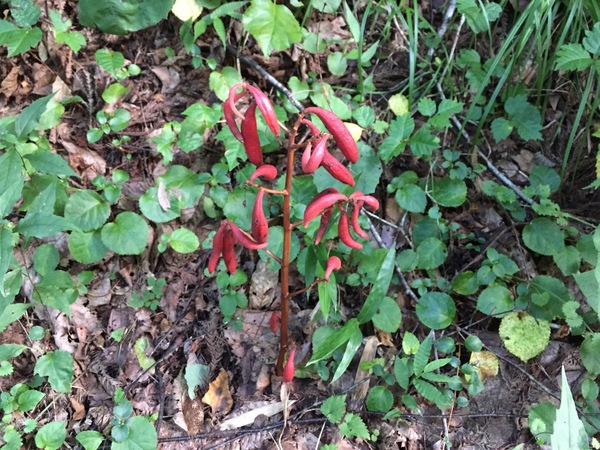
Japanese name: ツチアケビ(土通草) Scientific name:Cyrtosia septentrionalis
[Overview]
A terrestrial orchid 50–100 cm tall, found in deciduous forests and in thickets of dwarf bamboo; a mycoheterotrophic plant.
It has a thick, long, creeping rhizome.
Scale leaves grow on the rhizome.
It has no photosynthetic leaves above ground and depends for nutrients on its symbiotic fungus, naratake.
The stem is yellow, erect and thick, with sparse scale leaves.
A compound raceme at the top of the stem bears many flowers rather densely.
The flowers are 2.5–3 cm across, yellowish brown, and half open.
The sepals and lateral petals are oblong.
The lip is broadly ovate and thick, with a finely divided margin.
The fruit is an oblong, fleshy berry 6–10 cm long and 1.5–3 cm wide.
As the fruit ripens it hangs down, and it turns red together with the stem.
The fruit does not split open even when ripe.
[Uses]
The fruit is used as a folk medicine.
[Notes]
The Japanese name comes from the fact that it emerges from the soil and bears fruit like akebi.