
Plant Encyclopedia

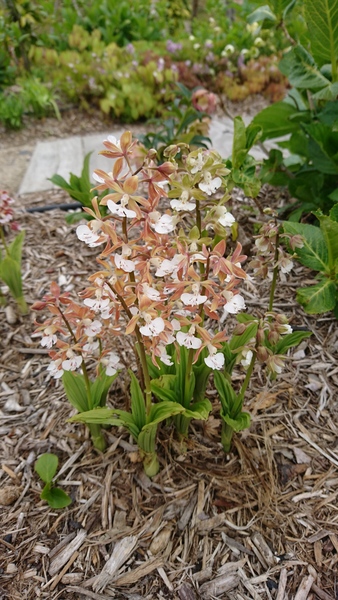
Calanthe discolor var. discolor ("Ebine")
Japanese name: エビネ (蝦根、海老根)
Scientific name: Calanthe discolor var. discolor
[Overview]
A perennial 20–40 cm tall, found in deciduous forests.
It has round pseudobulbs underground.
2–3 leaves emerge; they are elliptic, 15–25 cm long and 5–8 cm wide, with a pointed tip and entire margins.
The leaves have longitudinal wrinkles.
A raceme at the tip of a flower stalk bearing 1–2 scale leaves carries 8–15 flowers.
The scale leaves and the inflorescence have short hairs.
The bracts are lanceolate, 0.5–1 cm long.
The lateral petals and sepals are dark brown, narrowly ovate with pointed tips, and the lateral petals are narrower than the sepals.
The lip is fan-shaped, white to pale pink, deeply 3-lobed at the tip; the central lobe is further divided into 2 and has 3 raised ridges.
The spur is 0.5–1 cm long, shorter than the sepals.
[Cultivation]
Propagate mainly by division, but back bulb shoots and seed are also possible.
Grow in partial shade to shade, sheltered from dry winter north winds.
It is better to keep the air humidity high.
It prefers well-drained soil.
Water thoroughly when the soil surface dries.
From budding until the leaves finish growing, do not water from above, to prevent water collecting in the buds and causing soft rot.
In the growing season from spring to early summer, place a slow-release fertilizer high in nitrogen on the soil once a month; in summer, use one higher in phosphorus and potassium.
Pests and diseases include virus disease, soft rot, aphids, spider mites and slugs.
[Notes]
The Japanese name compares the linked corms to shrimp (ebi).
Details
Translated from our Japanese encyclopedia. If anything differs, the Japanese page is correct.