
Plant Encyclopedia

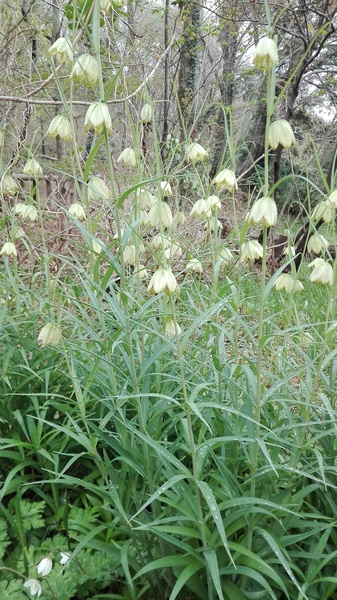
Fritillaria thunbergii ("Baimo")
Japanese name: バイモ (貝母)
Scientific name: Fritillaria thunbergii
[Overview]
A perennial 15–80 cm tall that, in its native range, is found in bamboo groves and shaded, damp places up to 600 m in elevation.
The aboveground parts die back around the rainy season, and it is dormant in summer.
Underground it has an ovate to spherical bulb 1–3 cm in diameter, made up of 2–3 white scales.
The leaves are simple, in whorls of 3–4, linear-lanceolate, 7–11 cm long and 1–2.5 cm wide.
On the lower part of the stem the leaves are opposite or alternate.
There are 12–20 leaves, and those on the upper part of the stem have tips that extend long into tendrils.
The flowers are borne singly, hanging downward, in the leaf axils on the upper part of the stem.
The flowers are bell-shaped with 6 petals, 2.5–3.5 cm long, pale yellow with a purple net-like pattern on the inside.
The fruit is a capsule.
The seeds have narrow wings.
[History]
In Japan it has been known since long ago, being mentioned even in the Engishiki (927), but it was actually introduced in 1724 (Kyoho 9).
[Uses]
The bulb is used medicinally.
[Cultivation]
Propagate by dividing the bulbs.
It prefers sun and humus-rich soil that is well drained and retains water well.
It dislikes heat and humidity, so in summer remove the withered leaves and move it to a cool, shaded, well-ventilated place.
To keep the bulbs through summer, dig them up when the aboveground parts wither, bury them in peat moss or the like so they do not dry out, and store them in a cool place.
It is cold-hardy and can overwinter outdoors as long as it is not frozen.
During the growing period, water thoroughly when the soil surface dries; during dormancy, water just enough that the bulbs do not dry out.
After flowering, apply slow-release chemical fertilizer as a thank-you fertilizer.
Aphids are a pest that can occur.
Details
Translated from our Japanese encyclopedia. If anything differs, the Japanese page is correct.