
Plant Encyclopedia

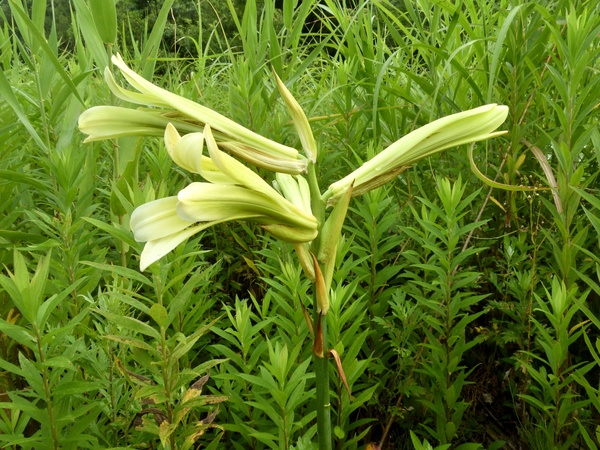
Cardiocrinum cordatum var. glehnii ("Obayuri")
Japanese name: オオウバユリ (大姥百合)
Scientific name: Cardiocrinum cordatum var. glehnii
[Overview]
A perennial 1–2 m tall, found in deciduous forests.
It is larger than Uba-yuri and bears many more flowers.
It has a bulb underground.
Young plants produce only basal leaves, but as the bulb grows, the stem becomes erect and the basal leaves disappear.
The leaves unfold from early spring, and several are borne in a whorl-like arrangement on the lower half of the stem.
The leaves are ovate-elliptic with a heart-shaped base and netted veins.
The leaves have long petioles.
The flower stalk grows from around May and bears a raceme with 10–20 flowers facing sideways.
The flowers are half-open, 6-petaled, 10–15 cm long and greenish white; they open in the evening and have a strong fragrance.
The fruit is an elliptical capsule; when ripe, only the upper part splits open, a structure that allows the seeds to be dispersed efficiently only on windy days.
The seeds are flat, about 1 cm long, with a broad membrane.
After flowering, the plant forms small bulbs and the parent plant dies.
[Uses]
The bulb is edible.
[Cultivation]
Propagate from seed.
Grow it in partial shade to shade.
Strong direct sunlight can cause leaf scorch.
It is not particular about soil, but prefers soil that is well drained and retains moisture well.
Take care not to let it dry out; for potted plants, water thoroughly when the soil surface dries, and for plants in the ground, rainfall is sufficient unless sunny weather continues and the soil dries out.
In spring, apply slow-release fertilizer placed on the soil.
There are no particular pests or diseases.
Details
Translated from our Japanese encyclopedia. If anything differs, the Japanese page is correct.