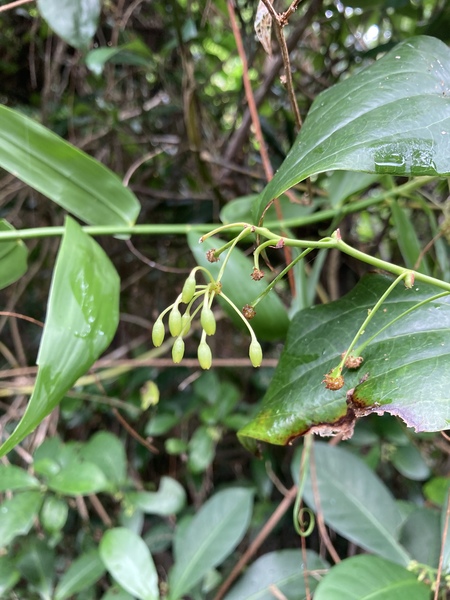
Japanese name: カラスキバサンキライ(唐鋤葉山帰来) Scientific name:Heterosmilax japonica
[Overview]
An evergreen climbing subshrub found at woodland edges and roadsides.
It is hairless throughout.
The stem is green and sparsely branched, without thorns.
Leaves are simple and alternate, ovate, 5–10 cm long, with a heart-shaped base; the upper surface is slightly glossy, and 5–7 veins are conspicuous.
The leaf margin is entire.
The petiole has a pair of long tendrils, which twine around other objects.
It is dioecious.
Both male and female flowers are borne in large numbers in umbels arising from the leaf axils; they are pale yellow with 6 tepals, and the perianth is fused, tubular in male flowers and urn-shaped in female flowers.
The fruit is a spherical berry 0.8–1 cm across, ripening black.
[Notes]
The Japanese name is said to derive from its resemblance to Sarutori-ibara (Sankirai) and from the leaves resembling the blade of a karasuki (a type of plow).