
Plant Encyclopedia

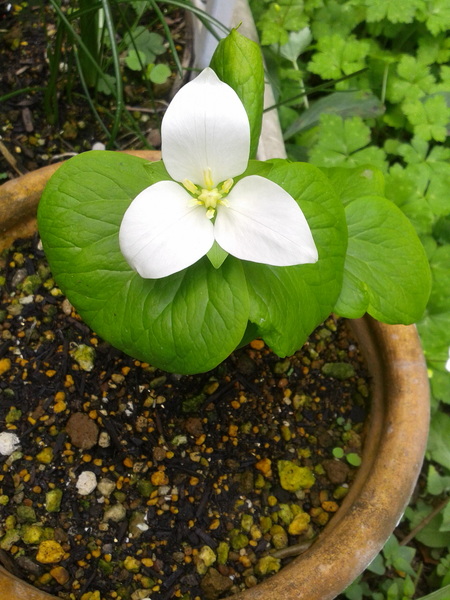
Trillium camschatcense ("Obananoenreiso")
Japanese name: オオバナノエンレイソウ (大花延齢草)
Scientific name: Trillium camschatcense
[Overview]
A perennial 20–40 cm tall, growing in moist places in woodland in open country.
It has a thick, short rhizome.
A single stem stands erect, with 3 leaves in a whorl at its tip.
The leaves are ovate-rhombic, about 6–17 cm long and equally wide, with entire margins and abruptly pointed tips.
A single flower is borne at the center of the leaves.
The flower has 3 green outer tepals and 3 white inner tepals.
The inner tepals are 2.5–4 cm long, longer than the outer tepals, and are not pointed at the tip.
The anthers are much longer than the filaments, and the ovary is ovoid-conical.
The fruit is a spherical, 3-ridged berry 1–2 cm across that ripens from green to blackish purple.
It is difficult to distinguish from Miyama-enreiso when not in flower.
[Uses]
Although poisonous, the rhizome is used medicinally.
[Cultivation]
Propagate from seed, but plants grown from seed take 5–10 years to flower.
The germination rate drops if the seeds dry out, so sow them fresh, in sandy soil, and take care that they do not dry out until germination.
It prefers fertile, well-drained soil, and sandy soil or soil for mountain wildflowers is suitable.
A sunny place is best from autumn to spring, and a cool place in partial shade to shade in summer; in the ground, plant it under deciduous trees.
During the growing season, take care that it does not run short of water; for potted plants, water thoroughly when the soil surface dries, and for plants in the ground, water as well if sunny weather continues and the soil dries out.
During dormancy, rainfall is sufficient.
In autumn, apply compost.
Aphids can occur.
Details
Translated from our Japanese encyclopedia. If anything differs, the Japanese page is correct.