
Plant Encyclopedia

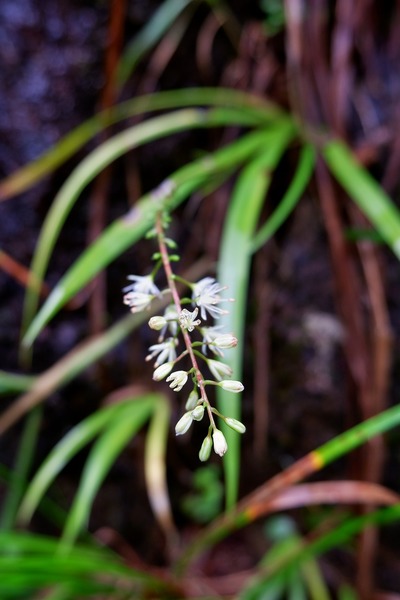
Tofieldia nuda var. nuda ("Hanazekisho")
Japanese name: ハナゼキショウ (花石菖)
Scientific name: Tofieldia nuda var. nuda
[Overview]
A perennial growing on rocky places in the mountains.
It has a short rhizome and does not produce stolons.
The leaves consist of basal leaves and 2–3 alternate leaves on the flower stalk; the basal leaves grow in a fan shape, are linear, 6.5–30 cm long, and have no small projections on the margins.
The leaves are folded along the midrib with the upper surface inside, so the lower surface faces outward.
There are 3–7 veins, and the veins continue to merge close to the leaf tip.
A raceme at the tip of a flower stalk about 8–35 cm tall bears 12–85 white 6-petaled flowers.
There are 6 stamens, equal to or slightly longer than the tepals, and the anthers are often more or less tinged with brown.
The flower stalks are at most 9 mm long, even the longest.
The fruit is an elliptic to ovate capsule that does not point downward.
The seeds have no tail-like appendages.
[Cultivation]
Propagate by division.
It prefers well-drained soil, and soil for mountain wildflowers or sphagnum moss alone is also fine.
A place with partial shade in summer and sun in other seasons is suitable; avoid strong direct sunlight and afternoon sun in summer, as they can scorch the leaves.
For potted plants, water thoroughly when the surface of the planting medium dries; for plants in the ground, rainfall is sufficient unless sunny weather continues and the soil dries out.
In spring and autumn, apply slow-release fertilizer placed on the soil.
There are no particular pests or diseases.
Details
Translated from our Japanese encyclopedia. If anything differs, the Japanese page is correct.