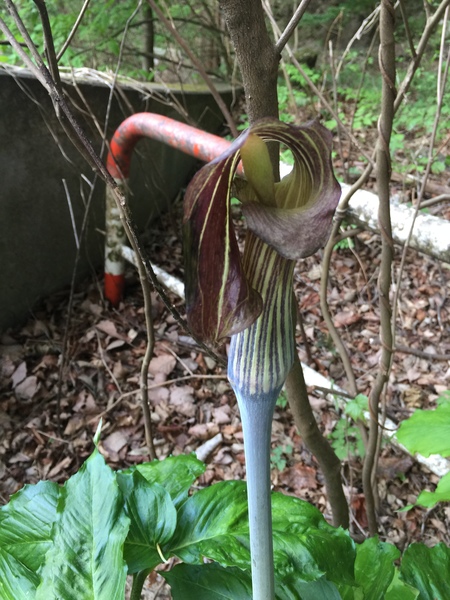
Japanese name: ミミガタテンナンショウ(耳形天南星) Scientific name:Arisaema limbatum
[Overview]
A perennial up to 70 cm tall, found in deciduous forests and at forest edges.
There is a flattened-spherical corm underground.
The sheathing leaves and the lower part of the petioles form a pseudostem.
There are 2 leaves, each with 7–11 leaflets arranged like a bird's foot.
The leaflets are lanceolate to elliptic and pointed, and often have white blotches along the midrib.
The leaf margin is entire, but sometimes toothed.
The inflorescence elongates earlier than the leaves; the inflorescence stalk is erect, taller than the petiole at flowering, and bears a spadix at its tip.
The appendage at the tip of the inflorescence is rod-shaped to club-shaped, erect, slightly swollen at the tip, and fully protrudes from the opening of the spathe.
The spadix is enclosed by the spathe.
The spathe is blackish purple to purplish brown or yellowish brown, rarely green, with white longitudinal stripes; the limb is triangular-ovate with a pointed tip.
The mouth of the spathe spreads widely like ears (a collar), and the open part is 8 mm or more wide.
The fruit is an ovoid berry that ripens red.
The plant is dioecious; young individuals are male and change to female as they grow.
[Uses]
Although poisonous, the corm is used medicinally.