
Plant Encyclopedia

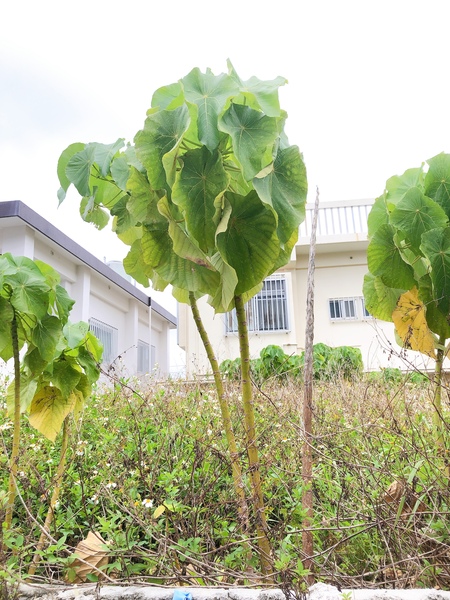
Hernandia nymphaeifolia (jack in the box, "Hasunohagiri")
Japanese name: ハスノハギリ (蓮葉桐)
Scientific name: Hernandia nymphaeifolia
[Overview]
An evergreen tree 7–20 m tall, growing near the seashore.
The trunk is thick and erect.
Young branches are green.
Leaves are simple and alternate, heart-shaped, 10–40 cm long and 8–20 cm wide, leathery and glossy, hairless on both sides, with entire margins.
A leaf stalk 5–15 cm long is attached peltately to the lower part of the leaf, and the veins are conspicuous.
New buds are densely covered with short hairs.
There are male and female flowers, which are small and white, borne in large numbers in corymbs arising at the branch tips or from the leaf axils.
Male flowers have 6 tepals, 3 stamens and 6 staminodes.
Female flowers have 8 tepals and 1 pistil, with a cup-shaped bract at the base.
The fruit is an ellipsoid 2 cm long that ripens black and is enclosed in a fleshy bract that ripens red or yellow.
[Uses]
The wood is soft and easy to work, and is used for utensils, geta (wooden sandals), chopsticks, canoes and the like.
The seeds are often used in crafts such as necklaces.
Although poisonous, the bark, seed oil and leaves are used medicinally, and also as a depilatory.
The seed oil can also be used for lighting.
It is planted as a windbreak against sea winds.
[Cultivation]
Propagate from seed or by cuttings.
A place that stays at 10°C or above is desirable for overwintering, so outside the subtropics and tropics, grow it in a pot and keep it in a bright place indoors in winter.
It prefers sunny, well-drained, calcareous soil.
For potted plants, water thoroughly from spring to autumn when the soil surface dries, and keep it on the dry side in winter.
Apply slow-release fertilizer in spring and autumn.
Diseases include leaf spot.
[Notes]
The Japanese name compares the leaves to those of the lotus (hasu) and the wood to that of the paulownia (kiri).
Details
Japanese: ハスノハギリ(蓮葉桐)
Translated from our Japanese encyclopedia. If anything differs, the Japanese page is correct.