
Plant Encyclopedia

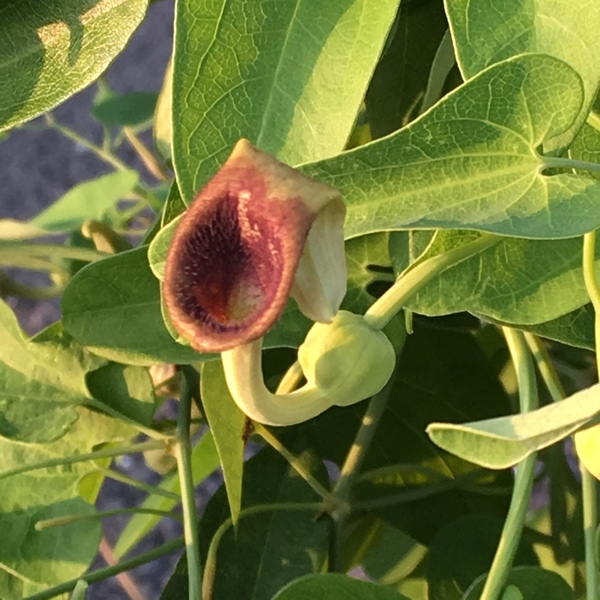
Aristolochia debilis ("Umanosuzukusa")
Japanese name: ウマノスズクサ (馬の鈴草)
Scientific name: Aristolochia debilis
[Overview]
A deciduous climbing perennial growing in hills and fields.
The whole plant has an odor.
The vines grow 2–3 m long.
The leaves are simple and alternate, narrowly triangular-ovate, 3–9 cm long and 2–5 cm wide, with a heart-shaped base and rounded ear-like lobes on both sides.
The leaves are rather thick, with entire margins.
The petiole is 1–2 cm long.
One or two flowers are borne in the leaf axils; they have no petals, and the calyx is well developed, with a curved calyx tube forming a distinctive shape like the musical instrument saxophone.
The base of the calyx tube swells into a sphere.
The inside of the calyx is purplish brown and densely covered with short hairs, and the calyx tip extends in a triangular shape with slightly recurved margins.
The fruit is a spherical to elliptic capsule 2–6 cm long, which splits into 6 when ripe.
The seeds are flat and winged.
Fruiting is rare.
[Uses]
Although poisonous, the root and fruit are used medicinally.
[Cultivation]
Propagate by division or shoot cuttings.
It prefers a place in sun to partial shade with soil that is well drained and retains moisture.
For potted plants, water thoroughly when the soil surface begins to dry; for plants in the ground, rainfall is sufficient.
In spring and autumn, apply slow-release fertilizer placed on the soil.
The vines grow long, so set up a support.
There are no particular pests or diseases.
[Notes]
It is a food plant of Jako-ageha.
Details
Translated from our Japanese encyclopedia. If anything differs, the Japanese page is correct.