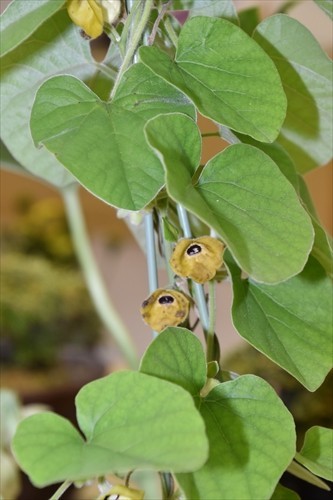
Japanese name: ビロードウマノスズクサ Scientific name:Aristolochia mollissima
[Overview]
A deciduous climbing shrub.
It is densely covered with white hairs all over, giving it a velvety texture.
The leaves are simple and alternate, round heart-shaped, 3.5–10 cm long and 2.5–8 cm wide.
The petiole is 2–5 cm long.
The flowers are borne singly in the leaf axils, yellow, about 4–5 cm across.
The flowers have no petals; the calyx is well developed and takes on a distinctive shape like the musical instrument, the saxophone.
The inside of the calyx has purple streaks, and the throat is purple.
The tip of the calyx is shallowly 3-lobed.
The fruit is a capsule 3.5 cm long and 1.5–2 cm wide, which splits open when ripe.
[Uses]
Although poisonous, the whole plant is used medicinally.
[Cultivation]
Propagate by division or by shoot cuttings.
It prefers a place in sun to partial shade with soil that is well drained and retains water well.
For potted plants, water thoroughly when the soil surface begins to dry; for plants in the ground, rainfall is sufficient.
Place slow-release fertilizer on the soil in spring and autumn.
Because the vines grow long, set up a support.
There are no particular pests or diseases.