
Plant Encyclopedia

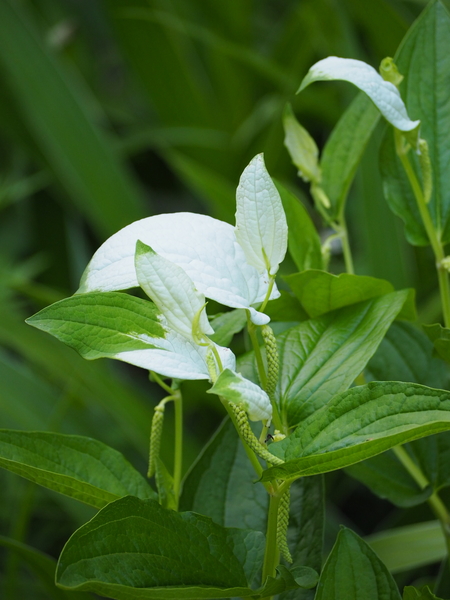
Saururus chinensis (Asian lizard's tail, "Hangesho")
Japanese name: ハンゲショウ (半夏生)
Scientific name: Saururus chinensis
[Overview]
A perennial 50–100 cm tall, growing in colonies at waterside and wetland sites in lowlands.
It has thick, horizontally creeping underground stems.
The whole plant has a distinctive odor.
Leaves are simple and alternate, ovate, about 5–15 cm long, with entire margins.
Five to seven veins are conspicuous on the leaves.
The petiole is 1–5 cm long.
A raceme 10–15 cm long is produced at the stem tip, opposite a leaf, and bears many small white flowers.
The flowers have no petals and open in order from the lower part of the inflorescence.
The inflorescence is at first drooping but later turns upward.
During flowering, the lower half of the leaf facing the inflorescence turns white and serves to attract insects.
This leaf turns green again when the plant is in fruit.
The fruit is spherical and follicle-like.
[Uses]
The whole plant is called sanpakuso as a crude drug and is used medicinally.
[Cultivation]
Propagate by division.
It prefers sunny, moist places with good water retention.
In poor light it becomes leggy and spindly, and the white coloring of the leaves does not develop well.
It is very sensitive to dryness, so it is best planted at the water's edge or grown in a pot standing in water.
If the environment suits it, it is easy to grow.
For plants in the ground, take care that the soil does not dry out; for potted plants, do not let the water in the saucer run out.
In spring to autumn, place slow-release fertilizer on the soil once a month.
There are no particular pests or diseases.
[Notes]
Theories on the origin of the Japanese name include that it comes from the flowers blooming around the time of hangesho (the 11th day after the summer solstice), and that the half-whitened leaves were likened to 'half makeup' (hangesho).
Details
Japanese: ハンゲショウ(半夏生)、カタシログサ(片白草)
Translated from our Japanese encyclopedia. If anything differs, the Japanese page is correct.