
Plant Encyclopedia

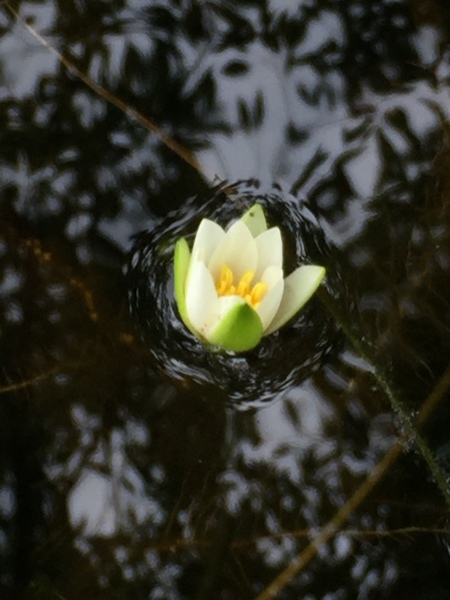
Nymphaea tetragona var. tetragona ("Hitsujigusa")
Japanese name: ヒツジグサ (未草)
Scientific name: Nymphaea tetragona var. tetragona
[Overview]
An aquatic perennial growing in shallow, poor to moderately nutrient-rich ponds and marshes.
It is entirely hairless.
It has a thick, short underground stem.
The leaves arise from the base, extending on long stalks from the underground stem to float on the water surface; they are ovate-round to elliptical, 8–19 cm long and 5–12 cm wide, with the base deeply notched into an arrowhead shape.
The underside of the leaf is tinged reddish purple, and the leaf margin is entire.
It also produces submerged leaves.
The flower is borne singly at the tip of a long stalk and floats on the water surface; it is white, about 5 cm across, with 8–15 petals, and has 4 green sepals.
There are many stamens.
The flower opens in the morning and closes at night, repeating this opening and closing movement for 2–3 days.
After flowering, the flower stalk twists spirally and sinks underwater, and the fruit ripens underwater.
The fruit matures enclosed in the calyx, and when ripe, the seeds, wrapped in an aril, float up to the water surface and are dispersed.
[Cultivation]
Propagate from seed.
It is best planted in paddy soil; for potted plants, sink the pot in water adjusted to a depth of about 5–30 cm, and for plants in the ground, a shallow place where the water does not exceed 1 m in depth is suitable.
It prefers a sunny place, but for potted plants provide shade as needed in summer so the water temperature does not rise too much.
Fertilizing can be sparing; from spring to autumn, while watching how it grows, push slow-release fertilizer or fermented oil cake into the soil.
[Notes]
The Japanese name is said to come from the flower opening at the hour of the sheep (hitsuji; around 2 p.m. today), but in fact it blooms from the morning.
Details
Translated from our Japanese encyclopedia. If anything differs, the Japanese page is correct.