
Plant Encyclopedia

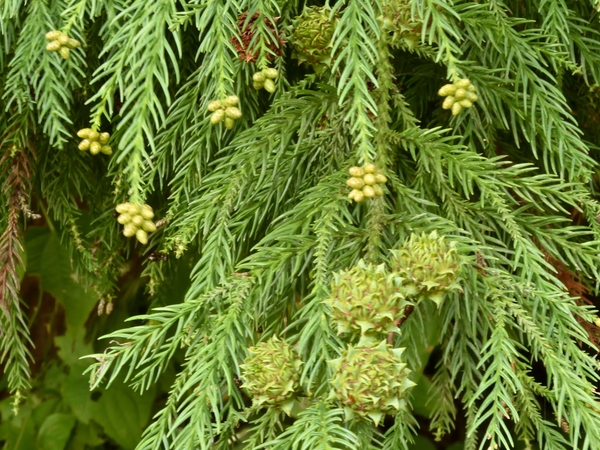
Cryptomeria japonica var. japonica (Japanese cedar, "Sugi")
Japanese name: スギ (杉)
Scientific name: Cryptomeria japonica var. japonica
[Overview]
An evergreen coniferous tree reaching 30–40 m in height and 1–2 m in diameter.
It is widely seen in mountain areas, but prefers moist, fertile places such as along streams.
The trunk is erect, and the crown forms a long cone.
The bark splits lengthwise and peels off in long, thin strips.
The leaves are densely arranged alternately in a spiral; they are sickle-shaped needles 4–12 mm long, slightly curved.
The leaves are green in summer and take on a brownish tinge in autumn to winter.
When the leaves die, they fall together with the twigs.
There are male and female flowers, both borne at the tips of twigs.
The male flowers are clusters of several stamens forming an oblong shape and release a great deal of pollen.
The female flowers are spherical.
The cones are spherical, 2–3 cm across, and ripen in autumn.
The seeds are 5–7 mm long and have a narrow wing on each side.
[Uses]
Together with hinoki, it is an important forestry tree, and its wood is used in a wide range of ways, including construction, ships, carving and utensils.
The bark is used for roofing as sugikawa-buki (cedar bark roofing).
The leaves are a raw material for incense sticks.
There is a children's game called sugidama-teppo, in which immature male flowers are packed into a thin bamboo tube to make an air gun.
[Cultivation]
Propagate by cuttings.
It prefers a fertile site with sun, good drainage and good water retention.
Young trees tolerate shade, but mature trees need a sunny place.
In dry or poor soil it gradually weakens, and it also dislikes waterlogged, excessively wet ground where water stagnates.
It is also sensitive to sea wind and air pollution.
Because it is adapted to the Pacific side, its branches break easily in snowy areas.
For young trees, whether potted or in the ground, water thoroughly when the soil surface dries.
For large specimens in the ground, rainfall is sufficient.
Apply organic fertilizer around the base in winter.
It tolerates pruning.
Pests and diseases include red blight, Sugi-dokuga (Japanese cedar tussock moth), Sugi-no-hadani (spider mite), and longhorn beetle larvae (teppo-mushi).
[Notes]
It is the largest and longest-lived of the trees native to Japan.
Some, such as the Jomon-sugi, are several thousand years old.
Details
Japanese: スギ(杉)、オモテスギ(表杉)
Translated from our Japanese encyclopedia. If anything differs, the Japanese page is correct.