
Plant Encyclopedia

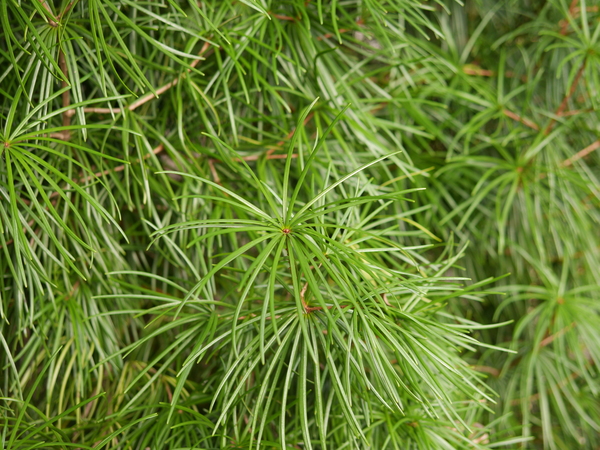
Sciadopitys verticillata (parasol pine, "Koyamaki")
Japanese name: コウヤマキ (高野槙)
Scientific name: Sciadopitys verticillata
[Overview]
An evergreen coniferous tree found on steep mountain ridges and rocky places, 30–40 m tall with a trunk diameter of 1 m.
The branches are differentiated into long shoots and short shoots.
The long shoots bear brown scale leaves about 2 mm long, arranged spirally.
Many short shoots are whorled at the nodes of the long shoots, and each bears a single leaf at its tip, so the leaves appear to be whorled on the branch.
The leaves are linear, 6–12 cm long and 0.2–0.4 cm wide; each looks like a single leaf, but it is actually two leaves turned inside out and fused at the sides, and the side that appears as the upper surface is in fact the original underside.
The fused part forms a longitudinal groove, and the groove on the back side has a white stomatal band.
There are male and female flowers; the male flowers are borne at the tips of the long shoots, with many stamens gathered into an ellipsoid 7 mm long, and 20–30 of these male flowers gather into a head 4 cm long.
The female flowers are borne 1–2 at the tips of the long shoots.
The fruit is a cylindrical-elliptical cone 6–12 cm long and 4–6 cm across, which ripens in autumn of the following year.
The cone bears fan-shaped seed scales arranged spirally, and each has 7–9 seeds on its inner side.
The seeds have narrow wings on both sides.
[History]
It has been protected on Koyasan as one of the Six Trees of Koya, and was protected by the Owari domain as one of the Five Trees of Kiso.
It is the personal emblem of Prince Hisahito of the Akishino family of the imperial family.
[Uses]
It is one of the world's three great garden trees.
The wood is resistant to water and moisture, so it is used for ships and bathtubs; the bark is used as makihada (caulking material) to prevent leaks in boats, tubs and the like.
It is also used for go boards, shogi boards, stakes and so on.
[Cultivation]
Propagate from seed or cuttings.
It can be planted from southern Hokkaido to central Kyushu.
It prefers sunny, well-drained, fertile soil, but dislikes strong sunlight on the base of the plant and strong afternoon sun.
It is weak to sea breeze and cold wind.
In dry, poor soil the plant weakens.
It is strongly shade tolerant, especially as a seedling.
Growth is slow in the seedling stage, and it begins to grow well from around the tenth year.
It dislikes transplanting, and transplanting mature trees is especially difficult.
For potted plants, water thoroughly when the soil surface dries; for plants in the ground, rainfall is sufficient unless sunny weather continues and the soil becomes severely dry.
For fertilizer in winter, apply organic fertilizer.
Do not prune hard; it is best to remove only unneeded branches, such as overgrown ones.
There are no particular pests or diseases.
Details
Japanese: コウヤマキ(高野槙)、ホンマキ(本槙)
Translated from our Japanese encyclopedia. If anything differs, the Japanese page is correct.