
Plant Encyclopedia

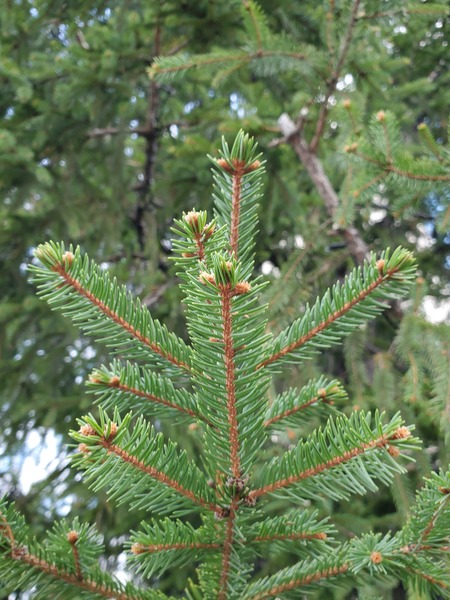
Picea abies (Norway spruce, "Doitsutohi")
Japanese name: ドイツトウヒ (独逸唐檜)
Scientific name: Picea abies
[Overview]
An evergreen coniferous tree native to Europe.
It grows fast, reaching 35–55 m in height and 1–1.5 m in trunk diameter.
The crown is conical, and the twigs droop as the tree ages.
The leaves are densely arranged alternately in a spiral, linear, 1–2 cm long, glossy and dark green.
The leaf is square in cross section, with stomatal bands on all sides.
There are male and female flowers; the male flowers are solitary in the leaf axils, 2–2.5 cm long and purplish red.
The female cones are borne at the tips of the previous year's branches, cylindrical, 4–5.5 cm long, and purplish red.
The fruit is a cone, brown and cylindrical, 8–16 cm long and 3–4 cm across, hanging downward.
The seeds have wings.
[Uses]
It is used medicinally and as a bath additive, and is also used as a Christmas tree.
[Cultivation]
Propagate from seed or by grafting.
Seeds are difficult to store, so sow them immediately after collecting, or store them so they do not dry out and sow in March–April.
It suits cool climates.
It dislikes transplanting when large.
It prefers fertile soil in a sunny, well-drained site.
Because it becomes a large tree, planting in the ground requires plenty of space.
For potted plants and for plants in the ground less than 2 years after planting, water thoroughly when the soil surface dries; for established plants in the ground, rainfall is sufficient.
Apply organic fertilizer around the plant as fertilizer in winter.
Because it is shallow-rooted, it is easily blown over by wind, so care is needed.
Pruning is limited to thinning out branches that spoil the shape of the tree, cutting them at the base.
There are no particular pests or diseases.
Details
Japanese: ドイツトウヒ(独逸唐檜)、オウシュウトウヒ(欧州唐檜)、ヨーロッパトウヒ
Translated from our Japanese encyclopedia. If anything differs, the Japanese page is correct.