
Plant Encyclopedia

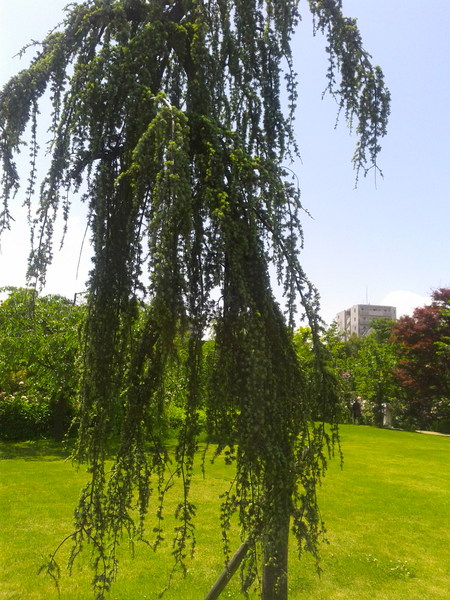
Larix kaempferi f. pendula (weeping Japanese larch, "Shidarekaramatsu")
Japanese name: シダレカラマツ (枝垂唐松、枝垂落葉松)
Scientific name: Larix kaempferi f. pendula
[Overview]
A deciduous coniferous tree.
The branches droop markedly.
The bark is dark gray and falls off in long scales.
The leaves are borne singly in a spiral on long shoots, and in clusters of 20–30 on short shoots.
The leaves are needle-shaped, 2–3 cm long and 0.1–0.2 cm wide, and green tinged with powdery white.
The leaves turn yellow in autumn.
There are male and female flowers; the male flowers are elliptical to long-ovate, 4 mm long.
The female flowers are borne at the tips of short shoots, and are reddish purple and ovate, about 10 mm long.
The cone is ovoid-globose, 2–3 cm long, at first greenish white and turning brown when ripe.
The seeds have long wings.
[Cultivation]
It is also planted in the Chugoku region, Shikoku and Kyushu, but good growth is limited to high-elevation areas of Hokkaido, Tohoku and the Chubu region.
It likes full sun very much, and sunny, dry places are suitable for its growth.
It tolerates poor and dry soil fairly well.
It has strong sprouting ability, and branches regenerate even from thick trunks.
It is weak against sea breezes, and its shape easily changes under the influence of wind.
Details
Japanese: シダレカラマツ(枝垂唐松、枝垂落葉松)
Translated from our Japanese encyclopedia. If anything differs, the Japanese page is correct.