
Plant Encyclopedia

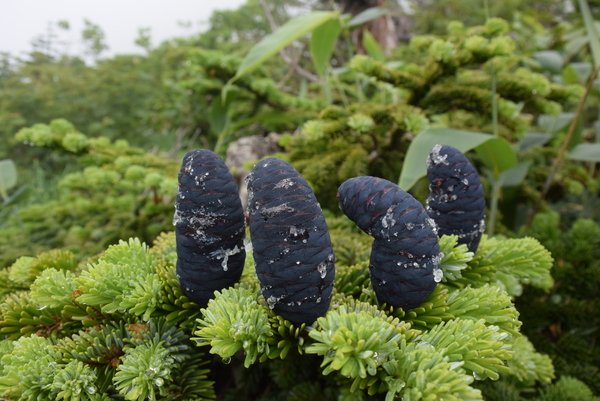
Abies mariesii (Maries' fir, "Oshirabiso")
Japanese name: オオシラビソ (大白檜曾)
Scientific name: Abies mariesii
[Overview]
An evergreen coniferous tree growing in the subalpine zone.
On the Pacific side it grows mixed with Tohi, Kometsuga, Shirabiso and others.
In heavy-snow areas on the Sea of Japan side it often forms pure stands.
The trunk is erect, and on flat ground with little wind it reaches 30 m in height and 1 m in diameter.
The bark is gray and smooth.
Young branches bear short brown hairs.
The leaves are linear, 15–20 mm long and 2.5 mm wide.
The underside of the leaf has two broad stomatal lines.
There are male and female flowers; the male flowers hang down from the leaf axils of the previous year's branches, with many stamens gathered in a spike.
The female flowers are also borne singly and upright in the leaf axils of the previous year's branches, and are cylindrical.
The fruit is an ovate-elliptical cone, 6–9 cm long and 3.5–4.5 cm in diameter, standing erect.
The cone ripens to blackish purple, and the bract scales are only half as long as the seed scales, so they do not protrude from between the seed scales.
After ripening, the scales of the cone fall apart, leaving the central axis.
The seeds are about 6–10 mm long, winged, and dispersed by wind in autumn.
[Cultivation]
Propagate from seed; because the seed is difficult to store, sow it immediately after collecting, or keep it from drying out and sow in March–April.
It prefers well-drained, fertile soil.
It is highly shade tolerant and does not like places that are too sunny.
Pests and diseases include longhorn beetle larvae (teppomushi).
Details
Japanese: オオシラビソ(大白檜曾)、アオモリトドマツ(青森椴松)、ホソミノアオモリトドマツ(細実青森椴松)
Translated from our Japanese encyclopedia. If anything differs, the Japanese page is correct.