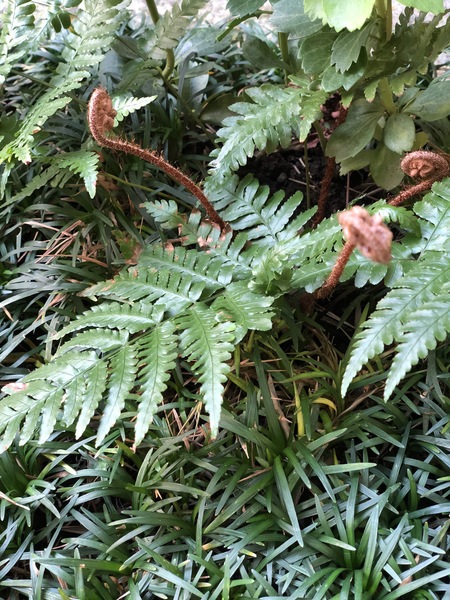
Japanese name: ベニシダ(紅羊歯) Scientific name:Dryopteris erythrosora
[Overview]
An evergreen fern commonly seen in evergreen broadleaf forests and along roadsides near villages.
It has a tuberous, obliquely ascending rhizome and the fronds grow in tufts.
The scales on the stipe are linear to linear-lanceolate and blackish brown, and the large ones reach 1.5 cm in length.
The fronds are 30–70 cm long and 20–35 cm wide, bipinnately compound, and vary greatly in shape and size.
There are about 10 pairs of lateral pinnae, which become smaller toward the top and have tips that extend into a tail.
The upper surface of the frond is slightly glossy.
The young shoots are tinged with red.
The stipe is 20–60 cm long and reddish purple while young.
The sori are borne midway between the pinnule axis and the margin of the pinnule, or closer to the midrib; the indusium is kidney-shaped to round, entire, and tinged with red when young.
[Cultivation]
It prefers partial shade and moderately moist, fertile soil.
Water when the soil surface is dry, taking care not to let it dry out.
If it dries out and growth suffers, the new shoots do not color.
Fertilizer is not particularly necessary.
Scale insects can occur.