
Plant Encyclopedia

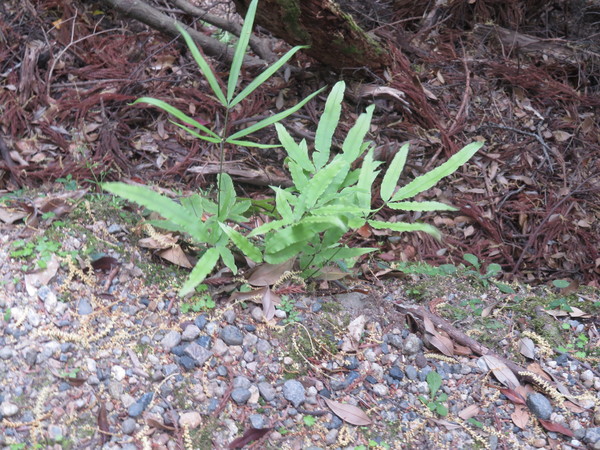
Pteris cretica (Cretan brake fern, "Obanoinomotoso")
Japanese name: オオバノイノモトソウ (大葉井之許草)
Scientific name: Pteris cretica
[Overview]
An evergreen fern found in somewhat damp places in forests, on stone walls and similar sites.
It has a short rhizome.
The rhizome bears brown, almost linear scales.
The leaves are somewhat dimorphic, with leaves that bear sporangia and leaves that do not.
The leaves are once-pinnately compound, 15–40 cm long and 6–35 cm wide, with 3–7 pairs of lateral pinnae.
The lowest 1–2 pairs of lateral pinnae bear 1–2 pairs of pinnules that closely resemble the upper lateral pinnae.
The pinnae are usually about 12 cm long, linear-lanceolate with a tail-like tip, and finely serrated.
The pinnae of the leaves without sporangia are wider than those of the leaves with sporangia.
Even the pinnae bearing sporangia are 1 cm or more wide.
The leaf stalk is usually 10–30 cm long, and longer in the leaves that bear spores.
The sporangia clusters extend long along the margins of the pinnae, and the leaf margins curl back to cover the sporangia.
[Cultivation]
Propagate by division.
It can overwinter outdoors in regions without frost, but potted plants are safer brought indoors to a sunny place in winter.
From autumn to spring it prefers a sunny place, and in summer a place protected from direct sunlight, with well-drained, fertile soil.
Be careful with watering, as the leaves wither if it dries out; for potted plants, water thoroughly from spring to autumn when the soil surface begins to dry, and keep it on the dry side in winter.
For plants in the ground, rainfall is sufficient.
In dry periods, mist the leaves.
From spring to autumn, apply slow-release fertilizer placed on the soil once every 2 months.
Spider mites can occur.
Details
Japanese: オオバノイノモトソウ(大葉井之許草)
Translated from our Japanese encyclopedia. If anything differs, the Japanese page is correct.