
Plant Encyclopedia

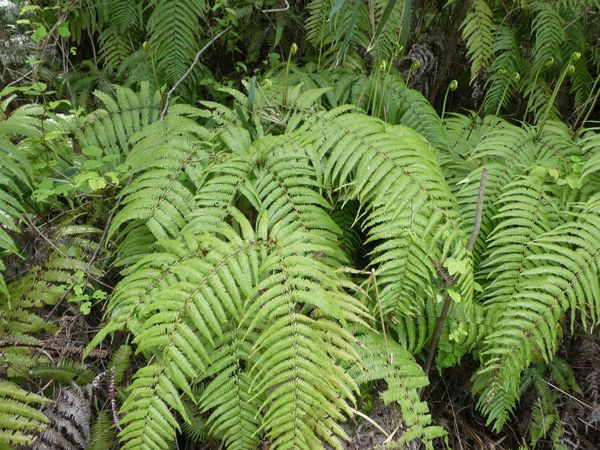
Diplopterygium glaucum ("Urajiro")
Japanese name: ウラジロ (裏白)
Scientific name: Diplopterygium glaucum
[Overview]
An evergreen fern found in sunny, dry places such as woodland edges and open fields in warm regions, often forming large colonies.
In Japan it reaches about 2 m in height, but in the tropics it grows to several meters.
The rhizome is 1 cm in diameter, hard and wiry, and creeps for a long distance underground.
The rhizome is rather densely covered with lanceolate, blackish brown to brown scales.
The leaf stalk is 30–100 cm long, erect, hard and smooth.
A pair of pinnae is borne at the tip of the leaf stalk; in the following years, a leaf stalk extends from between the pinnae and bears another pair of pinnae at its tip, and this is repeated, so that in the tropics growth continues almost without limit, whereas in Japan it mostly ends after 1–3 pairs of pinnae.
The pinnae are lanceolate to oblong-lanceolate, 50–100 cm long and 20–30 cm wide, and are bipinnate.
The pinnules are linear, 10–20 cm long and 0.8–3 cm wide, stalkless and deeply pinnately divided, with linear lobes that have rounded tips.
The pinnules and lobes meet the axis at almost right angles.
The upper surface of the pinnae is glossy, and the underside is waxy and white with stellate hairs.
The sori are arranged in a single row midway between the midrib and the margin, each consisting of 3–4 sporangia, and have no indusium.
[Uses]
The leaves are used for New Year decorations such as kagami-mochi (rice cake offering) and shimenawa (sacred straw rope), and also as kaishiki, a garnish placed under food and dishes.
The whole plant is used medicinally.
The leaf stalks are used as material for weaving baskets and similar items.
[Cultivation]
It dislikes having large clumps transplanted.
Details
Translated from our Japanese encyclopedia. If anything differs, the Japanese page is correct.