
Plant Encyclopedia

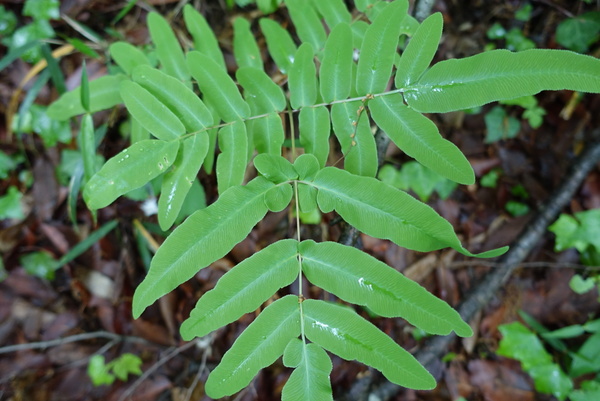
Osmunda japonica (Asian royal fern, "Zenmai")
Japanese name: ゼンマイ (薇、銭巻)
Scientific name: Osmunda japonica
[Overview]
A terrestrial fern found in mountain forests.
The rhizome is erect to ascending.
The leaves are of two kinds, sterile and spore-bearing; the sterile leaves are broadly ovate-triangular, 30–50 cm long and 25–40 cm wide, and bipinnately compound.
The pinnae are lanceolate, 5–10 cm long and 1–2.5 cm wide, becoming larger toward the bottom of the leaf, with fine serrations on the margins.
The pinnae have no stalks.
The spore-bearing leaves are taller than the sterile leaves, erect and bipinnately compound, with linear pinnae.
The sporangia are densely borne on both sides of the main vein.
The spore-bearing leaves wither soon after releasing their spores.
The young shoots are coiled like a spring and covered with pale reddish brown down.
[Uses]
The young shoots are used as a wild vegetable.
The down covering the young leaves is used as a substitute for cotton in textiles and futons, and for tinder (hokuchi).
[Cultivation]
It prefers fertile, well-drained sites in sun to partial shade.
For potted plants, water thoroughly when the soil surface dries; for plants in the ground, rainfall is sufficient.
If organic fertilizer is applied as a base fertilizer, no further fertilizing is particularly necessary.
There are no particular pests or diseases.
Details
Japanese: ゼンマイ(薇、銭巻)、ハゼンマイ(葉薇、葉銭巻)、シシゼンマイ(獅子薇、獅子銭巻)
Translated from our Japanese encyclopedia. If anything differs, the Japanese page is correct.