
Plant Encyclopedia

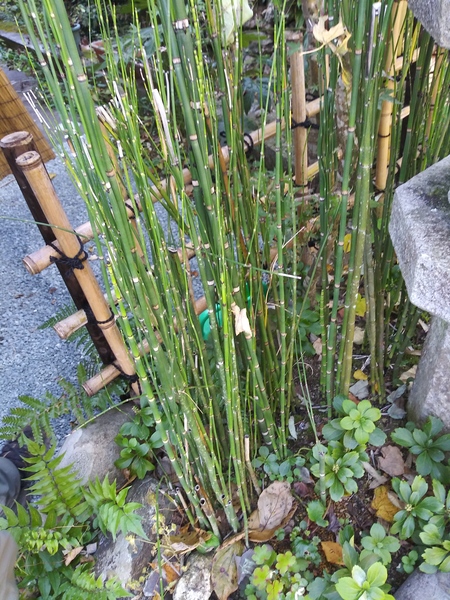
Equisetum hyemale var. hyemale (rough horsetail, "Tokusa")
Japanese name: トクサ (木賊、砥草)
Scientific name: Equisetum hyemale var. hyemale
[Overview]
An evergreen fern found in damp places such as the lower part of slopes inside mountain forests and wetlands along streams.
The underground stem creeps through the soil, and it often grows in colonies.
The vegetative and spore-bearing stems have the same form; they are usually unbranched, dark green, cylindrical, 2.5 mm or more in diameter, hard, and hollow, standing upright and sometimes exceeding 1 m in height.
The stem has 14–50 vertical grooves, and fine dots are arranged in two rows on the ridges, making it rough.
The leaves are reduced, blackish, whorled at the nodes of the stem, and fused at the base to form a leaf sheath.
This is the part called the "hakama" (skirt).
The sporangial spike is borne at the tip of the stem and is ovate, 0.7–3 cm long.
[Uses]
In addition to medicinal use, because it contains silica, the stems were used as an abrasive for wood and other materials.
[Cultivation]
Propagate by division or cuttings.
It can overwinter outdoors in areas where frost does not fall.
It grows well regardless of soil type as long as the soil is well drained and retains water well.
Partial shade suits it, and sun is also acceptable, but avoid strong western sun and direct sunlight in summer.
Also avoid places that become extremely dry and places exposed to strong wind, since the stems may break in strong wind.
When watering, take care to avoid both drying out and excess moisture; during the growing season water thoroughly when the soil surface dries, and in winter keep it somewhat on the dry side.
Fertilizer is not particularly necessary, but for potted plants liquid fertilizer may be given during the growing season as the plant's condition allows.
There are no particular pests or diseases.
[Notes]
The name derives from its use as an abrasive.
Details
Japanese: トクサ(木賊、砥草)、エダウチトクサ、ミガキグサ(磨草)、ヤスリグサ(鑢草)、ハミガキグサ(歯磨草)
Translated from our Japanese encyclopedia. If anything differs, the Japanese page is correct.