
Plant Encyclopedia

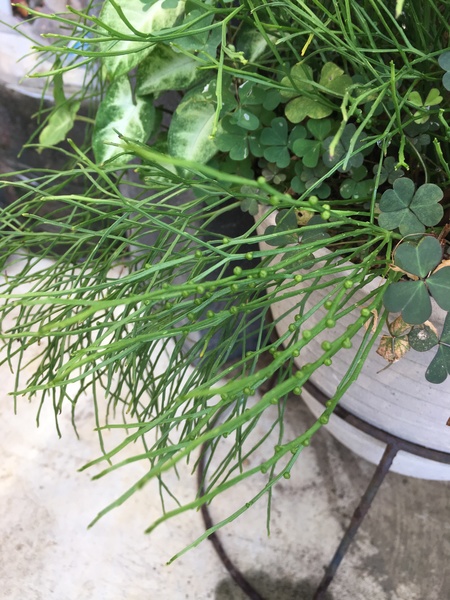
Psilotum nudum (whisk fern, "Matsubaran")
Japanese name: マツバラン (松葉蘭)
Scientific name: Psilotum nudum
[Overview]
An evergreen epiphytic fern 10–40 cm tall.
In warm regions it grows on trees, and near the northern limit of its range it grows in crevices in rocks.
The sporophyte has neither roots nor leaves, and consists only of a rhizome and aerial stems.
The rhizome branches densely in a forked manner and bears dense rhizoids.
The aerial stems repeat forked branching several times in three dimensions, standing upright or hanging down.
The branches have 3 ridges, and on the ridges there are small dagger-like projections.
The sporangial clusters are spherical, about 2 mm in diameter, borne one at a time on very short side branches from the branches, and turn yellow when ripe.
The spores are yellowish white.
[History]
One of the classical horticultural plants, it has been cultivated in Japan since ancient times; in the Edo period there were many garden cultivars, and the Matsuba-ran-fu (1836) records 125 cultivars.
[Cultivation]
Propagate by division.
It prefers a well-ventilated, well-drained environment and is planted in Kiryu sand or similar.
Sunlight requirements differ by cultivar.
Because it is a plant of warm regions, bring it indoors in winter in areas where frost falls.
When watering, use water that is as clean as possible, and water thoroughly when the soil surface dries.
Too much fertilizer damages the rhizoids, so use it sparingly, placing slow-release fertilizer on the soil in spring and autumn.
There are no particular pests or diseases.
Details
Japanese: マツバラン(松葉蘭)、ホウキラン(箒蘭)
Translated from our Japanese encyclopedia. If anything differs, the Japanese page is correct.