
Plant Encyclopedia

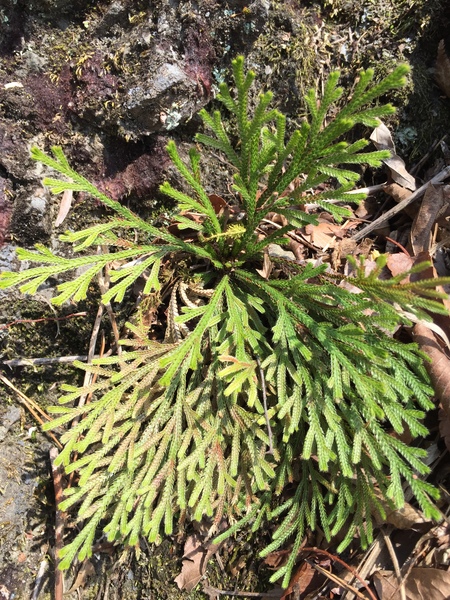
Selaginella tamariscina ("Iwahiba")
Japanese name: イワヒバ (岩檜葉)
Scientific name: Selaginella tamariscina
[Overview]
An evergreen fern found on rocks and cliffs in the mountains.
It has a false trunk that can reach 20 cm in height, and bears many branches radiating from the top of the false trunk.
It is resistant to drought, and when dry its branches curl inward.
The branches are about 10–20 cm long, branching pinnately two to three times to form an ovate outline.
The leaves consist of dorsal leaves borne on the upper side of the branch and ventral leaves borne on the sides of the branch, both arranged in two rows on the branch.
The dorsal leaves are ovate, with the tip drawn out long and thread-like.
The ventral leaves are distorted-ovate with fine teeth on the margin, and the tip is sharply pointed.
The spore-bearing spike is quadrangular-prism-shaped, 0.5–2 cm long and 0.2 cm in diameter, and is borne singly at the tip of a twig.
The margins of the sporophylls have fine teeth.
[History]
It is one of the classical horticultural plants, and many cultivars were developed and became fashionable in the Edo period.
[Uses]
It is used medicinally.
[Cultivation]
Propagate by division or bud cuttings.
It prefers a well-drained site in partial shade.
It dislikes strong direct sunlight and strong wind.
For potted plants, from spring to autumn water thoroughly after the soil has dried, also misting the leaves, and keep on the dry side in winter.
For plants in the ground, rainfall is sufficient.
If fertilizer is applied at planting, no further fertilizing is particularly necessary.
Pests and diseases include downy mildew, damping-off, cutworms, root-cutting worms and scale insects.
[Notes]
The Japanese name comes from the fact that it grows on rocky places and has a shape resembling the leaves of the hinoki (Japanese cypress).
Details
Translated from our Japanese encyclopedia. If anything differs, the Japanese page is correct.