
Plant Encyclopedia

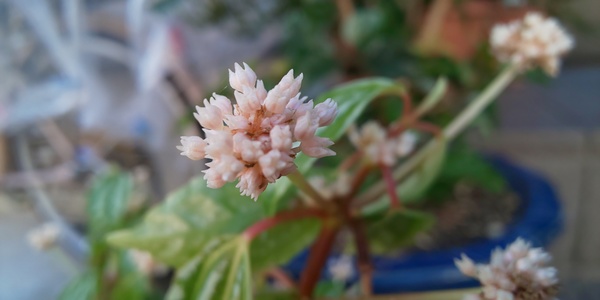
Pilea cadierei (aluminum plant)
Japanese name: ピレア カディエレイ
Scientific name: Pilea cadierei
[Overview]
An evergreen perennial 15–30 cm tall.
The stems are somewhat succulent, erect and branched, woody at the base, and form a clump.
The leaves are simple and opposite, elliptic to obovate, about 2.5–6 cm long and 1.5–3 cm wide, dark green, with three conspicuous veins and raised silvery white markings between the veins, arranged in four vertical rows.
The leaf margins have low serrations.
The plants are dioecious.
Paired cymes arise from the leaf axils; the inflorescences have long stalks and bear dense small yellowish white flowers.
The fruit is an achene.
It hardly ever flowers or sets fruit when grown indoors.
[Cultivation]
Propagate by cuttings.
It prefers a warm, humid environment, and should be kept at 5°C or above in winter.
When planting in soil, use soil that is well drained and retains water well; from spring to autumn water thoroughly when the soil surface dries, and keep it on the dry side in winter.
It tolerates shade, but grows better in a sunny place throughout the year; however, strong sunlight such as direct midsummer sun causes leaf scorch, so in summer keep it in bright shade.
In spring to autumn, apply slow-release fertilizer once every 2 months, or liquid fertilizer about once every 2 weeks.
Pests and diseases include leaf blight, anthracnose, slugs, spider mites and scale insects.
Details
Japanese: ピレア カディエレイ、アサバソウ、アルミニウムプランツ、ウォーターメロン・ピレア
Translated from our Japanese encyclopedia. If anything differs, the Japanese page is correct.